


Elvira Kadyrova
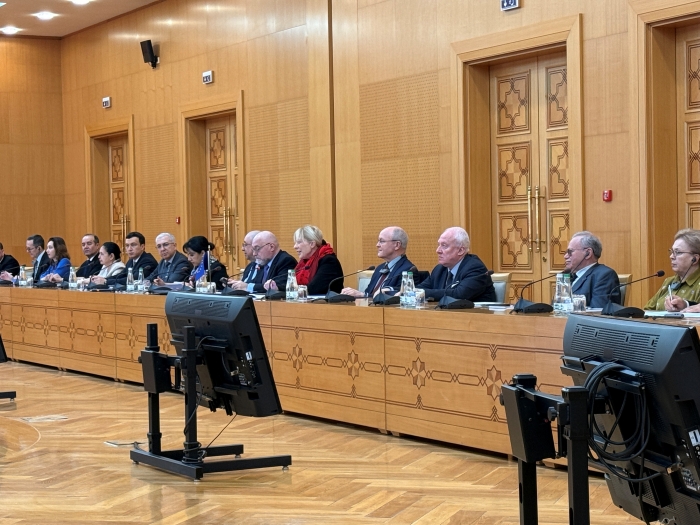
On 17 February 2026, the Ministry of Foreign Affairs of Turkmenistan hosted a press briefing dedicated to reviewing the outcomes of cooperation between Turkmenistan and the European Union in 2025, as well as discussing plans for engagement in the current year.
The event brought together a broad range of participants: representatives from Turkmen ministries and agencies, civil society, EU partners in the country, and both Turkmen and international media.
Key presentations were delivered by Deputy Minister of Foreign Affairs of Turkmenistan Mahri Bashimova and the EU Ambassador to Turkmenistan, Head of the EU Delegation Beata Pęksa. Additional remarks were provided by the Head of the Department of International Organizations at the Ministry of Foreign Affairs, German Ambassador Bernd Heinze, and French Ambassador Philippe Merlin.

The briefing featured a detailed overview of the major events and achievements in the Turkmen-European partnership agenda over the past year. Both sides emphasized the steady progress in relations and their mutual interest in further deepening cooperation.
Political Dialogue and Key Events in 2025
The year 2025 was marked by a series of significant high-level political contacts. In March 2025, Ashgabat hosted a meeting of foreign ministers from the Central Asian countries and the EU, which served as crucial preparation for the first EU–Central Asia Summit. The summit took place in April in Samarkand, Uzbekistan, and became a historic milestone: its outcomes included the adoption of a Joint Declaration confirming the parties’ intention to elevate relations to the level of a strategic partnership. Additionally, a Declaration of Intent was signed to deepen cooperation in the field of critical raw materials.
In October 2025, an additional ministerial meeting was held in an expanded format, involving foreign ministers from EU countries as well as representatives from Black Sea region and South Caucasus states.
Other notable events included visits by President of Turkmenistan Serdar Berdimuhamedov and the National Leader of the Turkmen People to EU countries, as well as visits to Turkmenistan by the EU Special Representative for Central Asia Eduards Stiprais, European Commissioner for International Partnerships Josef Síkela, and European Commission Vice-President and High Representative for Foreign Affairs and Security Policy Kaja Kallas. Turkmen representatives actively participated in meetings of finance and economy ministers.
In Ashgabat, the 24th meeting of the Turkmenistan–EU Joint Committee took place in November 2025, along with an interparliamentary dialogue. The human rights dialogue continued, as did the High-Level Dialogue on Security Policy EU–Central Asia and meetings of special representatives on Afghanistan.

Education, Capacity Building, and Institutional Development
One of the priority areas remains personnel training and institutional capacity strengthening. A special training program on EU foreign policy was organized for specialists from Turkmenistan and Kazakhstan. Eurostat regularly conducted training sessions for staff of the State Committee for Statistics of Turkmenistan.
Particular emphasis is placed on education and science. Through the regional project DARYA (“Dialogue and Action for Resourceful Youth in Central Asia”), initiatives are being implemented to develop youth skills aligned with future challenges. The project covered 10 events and trained 135 participants from the region.
Turkmenistan has intensified its engagement with the Horizon Europe program: in February 2025, experts visited the country, conducting seminars and consultations to expand national participation.

Transport, Energy, Ecology, and Green Development
The importance of transport connectivity has significantly increased within the framework of the EU’s Global Gateway initiative. Ongoing efforts focus on strengthening links between Europe and Central Asia, particularly through the development of the Trans-Caspian International Transport Route (also known as the Middle Corridor). A Turkmen delegation participated in the Investors Forum for this corridor, contributing to discussions on mobilizing investments for infrastructure modernization, logistics efficiency, and enhanced regional economic integration.
In the field of ecology and sustainable development, the program “EU for a Green Turkmenistan: Policy Dialogue and Climate Action 2024–2028” is being implemented in partnership with GIZ (Deutsche Gesellschaft für Internationale Zusammenarbeit), co-financed by the European Union and the German Federal Foreign Office. The initiative strengthens EU-Turkmenistan relations through policy dialogue on energy, environment, and climate policies; promotes the adoption of international and EU best practices and standards; and supports concrete actions in renewable energy, energy efficiency, methane emission reduction, and greenhouse gas mitigation.
Substantial attention is given to environmental protection, sustainable management of natural resources, climate change mitigation, and the development of renewable energy sources—including through the regional project SECCA (Sustainable Energy Connectivity in Central Asia).

Economy, Trade, and Support for WTO Accession
Cooperation with the International Trade Centre (ITC) aims to strengthen Turkmenistan’s global trade linkages and accelerate its WTO accession process. The Ready4Trade program continues to support the simplification of trade procedures in both the public and private sectors.
Other Directions and Projects
The EU and Turkmenistan implemented numerous projects in healthcare (in partnership with WHO), child rights protection (with UNICEF), and human rights and democracy (with the Institute of State, Law, and Democracy). Support was provided for conducting the Multi-Indicator Cluster Survey (MICS).
The latest phases of the BOMCA (Border Management Programme in Central Asia) and CADAP (Central Asia Drug Action Programme) programs were completed—with over 400 officials trained under BOMCA 10, contributing to stronger border security and facilitated trade. A restart of these programs is expected in 2026.
The EU actively engages with civil society organizations. In 2025, three grant projects were successfully completed:
- Enhancing women’s competitiveness in the private sector (in partnership with the Union of Economists of Turkmenistan);
- The “Infotech” project;
- A project to combat human trafficking, aimed at raising public awareness of migration risks and preventing illegal migration.
Overall, across various EU-led projects in 2025, 547 events were held, involving approximately 27,000 participants from Turkmenistan.


Plans for 2026: Further Strengthening of Strategic Partnership
At the press briefing, both sides placed particular emphasis on the prospects for cooperation in the current year. Turkmenistan and the European Union reaffirmed their mutual commitment to deepening multifaceted relations, encompassing political dialogue, economic interaction, green transformation, and humanitarian projects.
One of the key events of the year is expected to be a high-level visit to Brussels. Discussions on the agenda and exact dates of the visit are currently underway. It is anticipated that the visit will result in the signing of a package of important documents.
Political and Institutional Dialogue
A series of significant meetings and events are planned for 2026:
- The next round of interparliamentary dialogue between the Mejlis of Turkmenistan and the European Parliament;
- A new round of the human rights dialogue;
- The 5th high-level meeting of the EU program DARYA (scheduled for October), focused on preparing youth for future challenges;
- A meeting of the Turkmenistan–EU Joint Committee in Brussels;
- The High-Level Dialogue on security policy issues in Central Asia;
- A meeting of special representatives on Afghanistan.
In addition, on 26 March 2026, the Turkmenistan–EU Business Forum will take place in Ashgabat.


Border Security and Regional Projects
In 2026, the 11th phase of the BOMCA (Border Management Programme in Central Asia) will launch—a flagship EU project for border management in the region. The new phase will continue to strengthen institutional capacities, enhance training for officials, and promote safe and orderly cross-border trade.
Advancement of Women’s Rights, Decent Work, and Social Protection
The EU hopes for Turkmenistan’s participation in a new project to be implemented in cooperation with UNDP, UN Women, and UNFPA. The initiative focuses on empowering women across Central Asia.
Furthermore, the EU has decided to support cooperation between Turkmenistan and the International Labour Organization (ILO). A two-year project with a budget of 2 million euros will concentrate on promoting decent work, preventing child labour. It will allow ILO to launch some new trainings as well as building institutional capacity of Turkmenistan in implementing its own decisions concerning eradication of this possible problem.


Cultural, Humanitarian, and Environmental Dimension
In 2026, a number of cultural events are planned, including Days of European Culture in Turkmenistan, events dedicated to Europe Day, as well as some campaigns for saving our planet with active involvement of youth.
Both sides expressed confidence that the насыщенная agenda of 2026 will not only consolidate the results achieved in 2025, but also elevate Turkmen-European partnership to a qualitatively new level, contributing to sustainable development, security and prosperity of the region.///nCa, 17 February 2026