


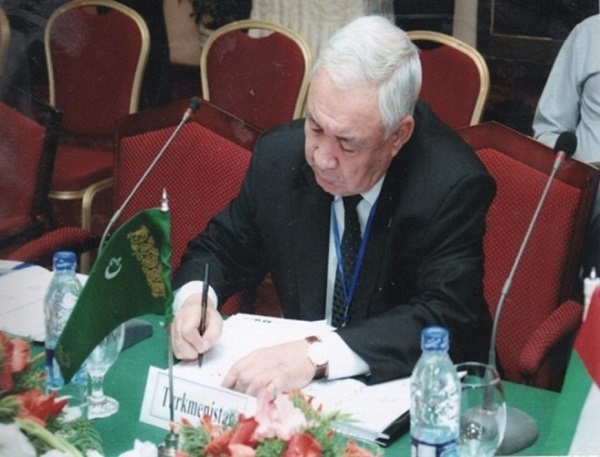
Sapar Berdiniyazov, Ambassador Extraordinary and Plenipotentiary Turkmenistan, Senior Lecturer at the Institute of International Relations of the Ministry of Foreign Affairs Turkmenistan.
In the Revival of a new era of the powerful state of Turkmenistan, providing every possible assistance to ensure peace and stability, strengthening friendly, fraternal relations and equal partnership with other states is an integral part of the foreign policy strategy of Turkmenistan, initiated by the National Leader of the Turkmen people, the Chairman of the Halk Maslakhaty, Hero Arkadag Gurbanguly Berdimuhamedov, and successfully implemented under the leadership of the President of Turkmenistan , Hero Arkadagly Serdar Berdimuhamedov.
In this regard, I would like to note that in the context of globalization, the importance of peace in international relations is growing. Peace is an example of combining traditional and modern functions and contributes to strengthening the bonds of friendship between states, adhering to the principles of equality, mutual respect, good neighborliness, mutual understanding, and trust.
As is well known, the year 2025, at the initiative of Turkmenistan, was held under the slogan “Peace and Trust.” This has become an important milestone in the history of not only Turkmenistan but the entire global community, opening new horizons for building a world based on trust, cooperation, and mutual understanding. It practically serves as an invitation and call to all states to begin working together to implement the ideas of peace and trust as a fundamental principle of world order. This year’s events clearly demonstrate Turkmenistan’s commitment to a constructive foreign policy strategy based on the principles of positive neutrality and designed to promote peace and stability in the regional and global spheres.
Throughout the year, a number of major and significant events were held both in Turkmenistan and abroad, the central one being the 3rd UN Global Conference on Landlocked Developing Countries in Avaza , which resulted in the adoption of a special UN General Assembly resolution, the Avaza Political Declaration, at the 80th anniversary session . This event demonstrates that Turkmenistan views the UN as a universal international platform, empowered by the international community to preserve and strengthen international peace and security and ensure the sustainable development of all states and peoples.
It is also appropriate to note the holding of the “International Year and Peace” forum in Ashgabat (Ashgabat Declaration, December 12, 2025), the “International Investment Forum,” the international conference and exhibition “Oil and Gas of Turkmenistan,” as well as the adoption of the Law of Turkmenistan “On the Legal Foundations of the Peace and Trust Policy of Neutral Turkmenistan” and the Regulation on Permanent Missions of Turkmenistan to International Organizations. I would also like to note that Turkmen diplomats actively participated in all events held both in Turkmenistan and abroad, making this a true triumph for Turkmen diplomacy.
Today is the Day of the Diplomatic Worker of Turkmenistan, established on February 18, 2009 by the Decree of the National Leader of the Turkmen people, Chairman of the Halk Maslakhaty, Hero Arkadag Gurbanguly Berdimuhamedov, is celebrated in the anniversary year – the 35th anniversary of the independence of our homeland, as well as in the context of the dynamic start of the implementation of the “Concept of the Foreign Policy of Turkmenistan for the period 2022-2028”, which was prepared with the aim of bringing to a qualitatively new level of peace-loving foreign policy of Turkmenistan, based on the principles of positive neutrality, built both on national interests and the interests of general well-being.
Strategic understanding and a comprehensive analysis of modern universal trends, a creative rethinking of the fundamental positions and long-term interests of Turkmenistan in the modern international system of coordinates became the basis for the adoption of this foreign policy document, which focuses on further integration into global processes of world development.
On this fundamental basis, Turkmenistan takes a fruitful and constructive part in international processes, contributing to the strengthening of peace, stability and security both regionally and globally.
They are consistent with the advancement and implementation of international initiatives by the Head of Turkmenistan, aimed at addressing pressing contemporary issues, establishing and maintaining a climate of mutual understanding and trust on the planet, and developing constructive interaction to ensure shared sustainable development. Their practical implementation is defined as the primary goals of Turkmenistan’s foreign policy.
Specifically, this concerns maintaining peace and ensuring peace and security, consistently developing good-neighborly relations and cooperation in the regions of Central Asia and the Caspian Basin, and promoting a peaceful, political settlement in Afghanistan and the socioeconomic recovery of that country. Turkmenistan systematically implements consistent measures to cooperate on energy, environmental, water, and other aspects of security, viewing the concepts of security as interdependent and indivisible.
Turkmenistan continues to engage in targeted cooperation with all interested parties to develop mutually agreed-upon actions within international organizations to promote the idea of creating a new international legal mechanism aimed at establishing a system of guarantees for sustainable energy supply in the world.
As the Leader of Turkmenistan notes, interest in Turkmenistan has grown significantly worldwide, with long-term and multifaceted ties being established, and the growing number of international contacts through various ministries and agencies are becoming increasingly substantive and substantive. The scale of Turkmenistan’s diplomatic presence worldwide is further evidenced by the fact that Turkmenistan has established and maintains diplomatic relations with 158 countries, opened diplomatic missions in more than 30 countries abroad, and has accredited more than 52 diplomatic missions of foreign states in our country. Turkmenistan is a member of 54 international and regional organizations, and has acceded to more than 169 international conventions and treaties.
On March 2, 1992, Turkmenistan became a member of the UN, opened its permanent mission to the UN and actively interacts with its specialized organizations such as UNESCO, UNICEF, UNDP, UNIDO, WHO, the UN High Commissioner for Refugees, ECOSOC, the UN Office of Counter -Terrorism , and a number of UN Committees.
Turkmenistan’s neutral policy, a fundamental pillar of its foreign policy, pursues global goals: achieving universal peace, social progress, and economic prosperity. This is evidenced by the opening of the UN Regional Center for Preventive Diplomacy for Central Asia in Ashgabat. Its activities promote and strengthen dialogue between Central Asian states through mediation; support regional programs to prevent violent extremism and counter terrorism; and advance cooperation on climate change and sustainable transboundary water management, as well as promote global agendas such as “Women, Peace and Security” and “Youth, Peace and Security,” in accordance with UNSC resolutions. This fact alone testifies to Turkmenistan’s high standing in the world and the deep respect it enjoys from regional states, major international organizations, and, of course, the United Nations. In this context, it is important to note that Turkmenistan’s policy of positive neutrality creates broad opportunities for advancing multilateral diplomacy, including economic, energy, transport, water, scientific and educational, cultural, humanitarian, parliamentary, medical, environmental, youth, and sports diplomacy. And, of course, all of this contributes to strengthening friendly and trusting relations between countries and peoples and developing mutually beneficial cooperation in various fields.
Today, Turkmenistan’s space and scope of cooperation have significantly expanded, reaching more than 115 countries, both bilaterally and multilaterally. Turkmenistan’s current focus includes the Asia-Pacific region, Europe, the Americas, the Middle East, Africa, and Australia. Turkmenistan’s cooperation with major international organizations, primarily the UN, the European Union, the OSCE, the Organization of Islamic Cooperation, the Economic Cooperation Organization, the CIS, the SCO, and other major international organizations, also serves this goal.
Turkmenistan’s participation in the activities of the above-mentioned international organizations, as well as in accordance with the concept of Turkmenistan’s foreign policy for the period 2022-2028, allows Turkmenistan to more effectively implement the foreign policy initiatives put forward by the Leader of the Nation, the Chairman of the Halk Maslakhaty , Hero Arkadag Gurbanguly Berdimuhamedov and President of Turkmenistan Serdar Berdimuhamedov at UNGA sessions, other international organizations, summits, and high-level meetings. These include the creation of a UN Energy Council, the establishment of a permanent forum for security and cooperation in Central Asia and the Caspian Basin, facilitating a political settlement in Afghanistan, the development of transit and transport corridors between the Caspian, Black, and Baltic Seas, Central Asia and the Middle East, Central Asia and China, and many other important initiatives.
Turkmenistan successfully pursues bilateral and multilateral diplomacy in its foreign policy. This is evidenced by the targeted visits of the Leader of the Nation, Gurbanguly Berdimuhamedov , and the President of Turkmenistan, Serdar Berdimuhamedov , to various foreign countries, visits by heads of state and government of foreign countries to Turkmenistan, Turkmenistan’s participation in numerous international conferences and seminars, regular consultative meetings of the Leaders of Central Asian countries, and the Caspian Basin Summit. Turkmenistan’s active participation in Central Asian formats, including the Central Asian Plus One Dialogue, has become a platform for dialogue with partners outside the region. Currently, more than 10 such dialogue platforms are functioning with nearly 40 countries and several regional organizations, as well as regularly held Inter-Ministerial Political Consultations and Intergovernmental Commissions on Trade and Economic Cooperation.
Today, Turkmenistan is actively and successfully implementing its foreign policy priorities, including transport, energy, water diplomacy, cultural and public diplomacy, trade, sports diplomacy, and parliamentary diplomacy. This is evidenced by the construction of the Serkhetaba -Turgundi-Herat (Afghanistan) railway, the commissioning of the Kazakhstan-Turkmenistan-Iran railway, the construction of the Imamnazar-Aqina-Andkhoy (Afghanistan)-Tajikistan railway , the construction of power lines between Turkmenistan and Afghanistan and Pakistan, and the construction of gas pipelines between Turkmenistan and Afghanistan- Afghanistan-Pakistan-India and the fourth line of the Turkmenistan-China gas pipeline, laying of fiber-optic communication Turkmenistan-Afghanistan-Pakistan, construction of multi-purpose bridges across the Amu Darya, creation of modern architecture of the Great Silk Road, establishment of transport and transport-transit corridors such as Afghanistan- Turkmenistan-Azerbaijan-Georgia-Turkey-Europe, Uzbekistan-Turkmenistan-Iran-Oman-Qatar, construction of high-speed highways Ashgabat-Turkmenbashi, Ashgabat-Mary-Lebap, Ashgabat-Dashoguz, trans-Caspian corridor and others.
All of the above examples once again demonstrate the significant improvement in the quality of Turkmenistan’s foreign policy and diplomacy in the new era of happiness, power, and historical transformation, while the main vector of its foreign policy remains unchanged—the country’s constant neutrality, aimed at cooperation for peace and progress.
One of the significant priorities of foreign policy and diplomacy of Turkmenistan is commitment to develop cultural and humanitarian cooperation in the international arena, which undoubtedly contributes to the rapprochement of countries and peoples and the strengthening of friendship and peace. Culture, science, and education have always formed the foundation for shaping and maintaining the lofty ideals of peace and humanism, friendship, and trust.
In this context, cultural cooperation, as an integral part of the country’s state policy in the international arena, is aimed at integrating the country into the global intellectual space. Turkmenistan views interaction in this area as a powerful tool for mutual understanding and friendship between peoples and states. Cultural relations and ties enable the international community to become familiar with the country’s culture, utilize cultural exchanges and other cultural projects to enhance the country’s prestige, and create favorable conditions for improving cooperation in key areas, such as economics and politics. As defined in the Concept, Turkmenistan’s cultural cooperation will develop in line with modern realities and public demands, the advancement of information technology, and the emergence of new forms of mutual communication in line with contemporary global trends. Along with new initiatives, it is envisaged to continue and expand the practice of holding Days of Culture of Turkmenistan abroad and Days of Culture of other countries in Turkmenistan, as well as organizing international cultural and arts festivals in Turkmenistan.
Turkmenistan’s modern diplomatic service is built on a solid foundation of high-level government support and comprehensive training, selection, and placement of highly qualified personnel. Established at the initiative of the Leader of the Nation of Turkmenistan, the Institute of International Relations of the Ministry of Foreign Affairs of Turkmenistan is a higher education institution.
Today, Turkmenistan’s Foreign Service is rightfully proud of its accumulated experience and achievements. Turkmen diplomats ably defend the country’s interests and significantly enhance its prestige on the global stage. A constant foreign policy mission remains the initiative to address pressing contemporary issues and strengthen fruitful cooperation to ensure peace, security, and sustainable development on the planet.
Thus, in connection with the above, taking into account the important, significant and targeted documents adopted during the above-mentioned events, as well as taking into account the country’s foreign policy priorities outlined by the President of Turkmenistan at the anniversary session of the UNGA, it can be said with confidence that on this significant day, celebrating their professional holiday, Turkmen diplomats will continue to steadily implement a foreign policy course based on the principles of “Open Doors”, peacefulness, good-neighborliness and fruitful partnership, and will also contribute to the further strengthening of the country’s international authority, increasing its role in solving pressing problems of our time. /// nCa, 17 February 2026
About the author: Sapar Berdyniyazov is a distinguished veteran Turkmen diplomat and senior lecturer at the Institute of International Relations of the Ministry of Foreign Affairs of Turkmenistan. With nearly 50 years of experience, including service in Pakistan (Karachi, Islamabad) since 1977, he is recognized for his expertise in Asian diplomacy, particularly in fostering Turkmenistan-Pakistan relations.