


Tariq Saeedi
In a captivating dialogue at the World Economic Forum in Davos 2026, Elon Musk, the visionary behind Tesla, SpaceX, and xAI, emerged as the ultimate authority on innovative, boundary-pushing ideas.
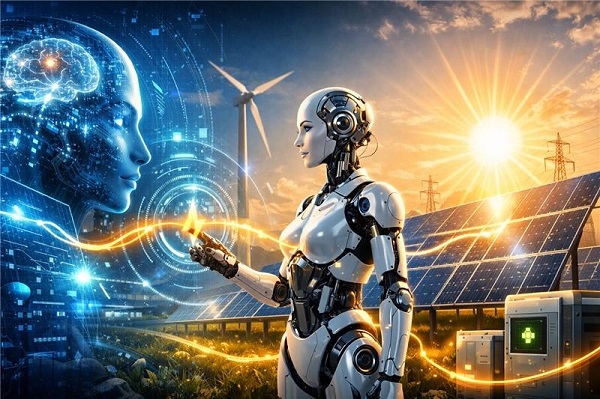
Joined by BlackRock CEO Larry Fink, Musk outlined a powerful “troika” of technologies—AI, humanoid robotics, and alternative energies, especially solar power—that he believes could usher in an era of “sustainable abundance” for the world. As he put it, “if AI, robotics and solar power can be deployed more broadly, they could unlock an era of unprecedented global abundance.”
This vision isn’t just theoretical; it’s a call to action, particularly for regions like Central Asia, where vast landscapes and emerging economies could leapfrog into a prosperous future by prioritizing these pillars.
Musk’s optimism shines through in his emphasis on how these technologies interconnect to solve real-world challenges.
On AI and robotics, he argued that “ubiquitous AI that is essentially free or close to it and ubiquitous robotics” could spark an “explosion in the global economy that is truly beyond all precedent.” Humanoid robots, he suggested, might redefine productivity by handling everything from industrial labor to elder care, effectively multiplying economic output as “the average productivity of a robot multiplied by the number of robots deployed.”
Yet, he warned that energy remains the bottleneck: “We’re very soon going to be producing more chips than we can turn on,” highlighting the urgent need for scalable power sources.
This is where solar energy takes center stage in Musk’s blueprint. He pointed out that “roughly 100 miles by 100 miles of solar is enough to power the entire United States,” underscoring its potential to overcome electrification limits.
For Central Asia, with its abundant sunlight and expansive deserts, this presents a golden opportunity. Countries in the region should sharpen their focus on generating electricity from solar and other sustainable sources, investing in large-scale panels and grids to fuel AI data centers and robotic manufacturing.
Musk even nodded to China’s rapid solar expansion as a model, while revealing Tesla and SpaceX’s push for 100 gigawatts of annual solar capacity in the US—proof that bold scaling is achievable.
To make this troika a reality, Central Asia must foster collaboration through public-private partnerships in research, innovation, and science centers. These hubs could accelerate the acquisition and promotion of AI and humanoid robotics know-how, adapting global tech to local needs like agriculture automation or resource management.
As Musk reflected, “We are in the most interesting time in history,” and with his forward-looking philosophy, erring on the side of optimism could transform Central Asia from a crossroads of history into a powerhouse of sustainable abundance. /// nCa, 28 January 2026