


Tariq Saeedi
This is a kind of lightweight analytical look at the Davos 2026 and some of the things that may relate to Central Asia.
We have divided the narrative into three sections:
- Matters of Interest for Central Asia
- Matters of Concern for Central Asia
- Pre-Davos vs. Post-Davos Scenarios for Key Global Processes
Participants from Central Asia at Davos 2026
The World Economic Forum Annual Meeting 2026 concluded on January 23, 2026, with nearly 3,000 participants from over 130 countries, including a record 65 heads of state and government.
Central Asian representation was essentially tied to specific events like the signing of U.S. President Donald Trump’s “Board of Peace” charter on January 22. Key attendees included:
- Kazakhstan: President Kassym-Jomart Tokayev attended on January 22 to sign the Board of Peace charter, holding talks with Trump and others. Dana Shukirbayeva, a Global Shaper and scientist from Astana, participated in climate and AI sessions. Kazakhstan was highlighted in economic discussions as a growth market.
- Uzbekistan: President Shavkat Mirziyoyev arrived on January 21 and signed the Board of Peace charter on January 22, engaging in multilateral talks on peace, investment, and diplomacy. Regional business interests in energy and trade were noted.
- Other Central Asian Countries: No confirmed high-level attendees from Kyrgyzstan, Tajikistan, or Turkmenistan. Azerbaijan (associated with Central Asia through C6) had President Ilham Aliyev present, discussing energy and stability, potentially benefiting Central Asia via Silk Road corridors.
Central Asia’s involvement was largely event-specific, reflecting the region’s strategic positioning amid great-power competition, with leaders like Tokayev and Mirziyoyev leveraging the forum for diplomatic visibility.
Matters of Interest for Central Asia
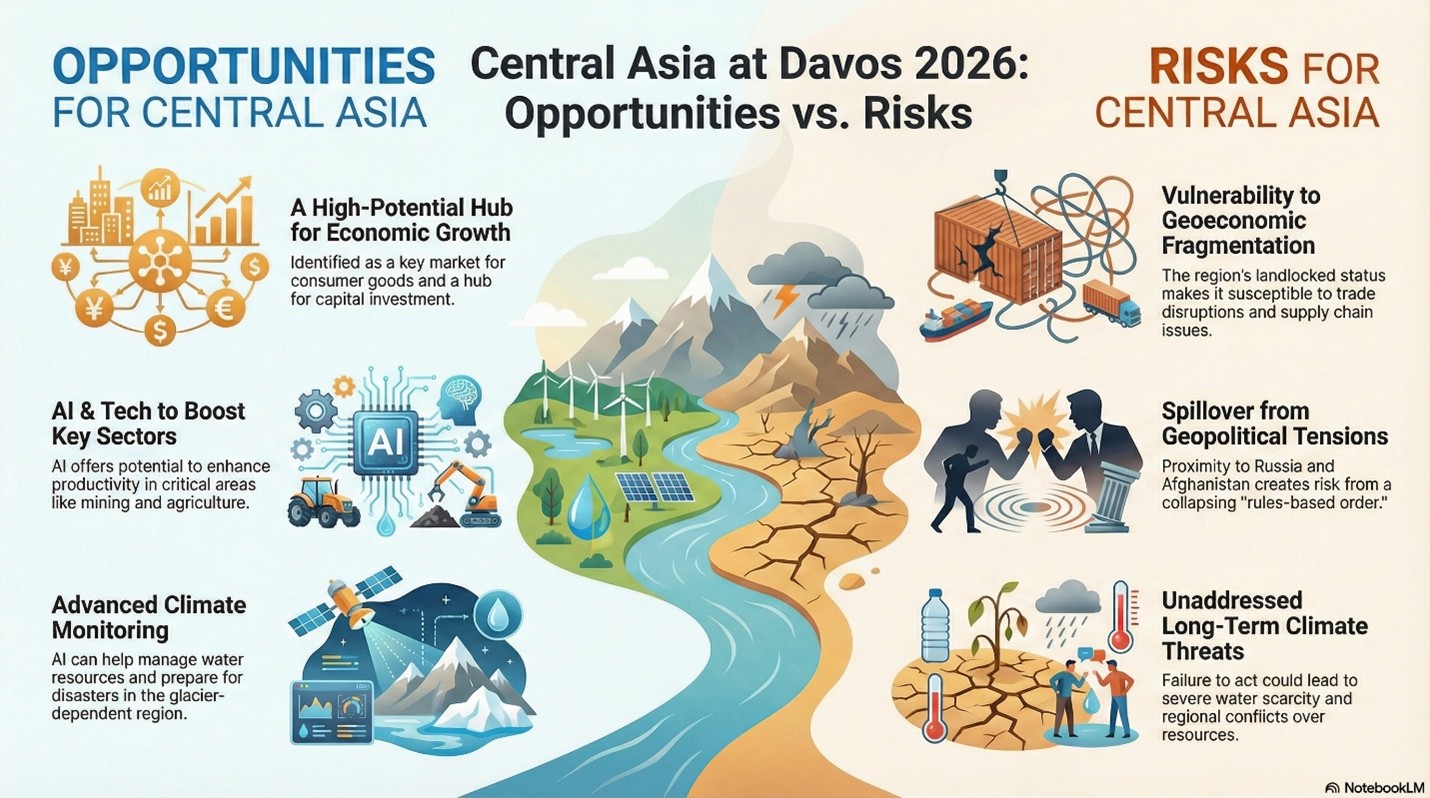
Davos 2026 outcomes offer opportunities for Central Asia, leveraging its resources, location, and reform momentum. There are enhanced diplomatic ties via the Board of Peace.
- Peace and Diplomatic Initiatives: Kazakhstan and Uzbekistan’s signing of the Board of Peace (focused on Gaza reconstruction and global conflicts) positions them as founding members alongside 17 others, potentially opening avenues for mediation roles. — This elevates Central Asia’s global profile, fostering partnerships with the U.S. and others for stability in neighboring regions like Afghanistan, enhancing security and aid inflows. However, the observers are skeptical about the long-term viability of the Board of Peace.
- Climate and Environmental Monitoring: AI-driven climate tools were emphasized for vulnerable regions like Central Asia, facing rapid warming and data shortages. — Partnerships could improve water and disaster management, crucial for agriculture and preventing conflicts over shared resources.
- Economic Growth and Investment: Global growth projections (3.3% for 2026) highlight Central Asia as a consumer market, with firms like Carlsberg eyeing expansion. China’s Belt and Road echoes provide investment hubs. — Attracting FDI in infrastructure could boost jobs and GDP amid supply chain diversification.
- AI and Technological Innovation: Ethical AI governance and productivity boosts were key, with calls to close innovation gaps. — Adoption in mining and agriculture could enhance competitiveness in a tech-driven “age of competition.”
- Global Cooperation on Health and Sustainability: UNFPA sessions on women’s health and clean energy transitions align with regional needs. — Investments could address demographics and scarcity, with EU/Qatar partnerships amplified by Board of Peace ties.
Matters of Concern for Central Asia
Risks from Davos discussions could heighten Central Asia’s vulnerabilities, including external dependencies and shocks. No major changes, but Trump’s dominance amplified geopolitical uncertainties.
- Geoeconomic Confrontation and Fragmentation: Top risks include trade slowdowns (0.9% in 2025), debt, and multipolarity without cooperation. — Overlap of political posturing into economic spheres by some sides could add to the cost of competitiveness for Central Asia, though it may also induce deeper mutual dependance.
- Geopolitical Tensions and Security Risks: U.S.-Europe strains over Greenland, plus nationalism, risk spillovers. — This could further crystalize the polarization on one hand and the rethinking of partnerships and their multifaceted impact on the other.
- Misinformation and Societal Polarization: Short-term threats erode trust, risking ethnic divides. — The probable ways to define misinformation and deal with it may have grassroots impact, if not handled properly.
- Climate and Long-Term Risks: Unmitigated affordability crises threaten ecosystems. — Without timely and adequate action, water scarcity may spark regional disputes.

Pre-Davos vs. Post-Davos Scenarios for Key Global Processes
US-Iran Conflict
- Pre-Davos: Tensions peaked after U.S. strikes on Iranian nuclear sites in June 2025 and Tehran’s crackdown on protestors in January 2026. President Trump threatened to strike Iran and ordered relocation of some strategic military assets. Iran’s airspace closed temporarily. Risks for Central Asia included varying degrees of trade and transit disruption, potential obstruction of supply chains and likely wave of refugees.
- Post-Davos: Iran’s FM was disinvited due to the crackdown. Trump sent a U.S. “armada” toward Iran, renewing threats while hoping not to use it; Iran warned of retaliating against U.S. regional investments. — From passive monitoring to active deterrence, though Board of Peace could mediate if expanded.
Trump’s Greenland Acquisition Ambition
- Pre-Davos: Aggressive pursuit included tariff threats and force not ruled out, framing it as security against Russia/China. Risked transatlantic rupture.
- Post-Davos: Trump announced a “framework deal” with NATO for U.S. “total access” to minerals, bases (possibly sovereign U.S. territory), and Golden Dome integration, dropping tariffs and ruling out force; renegotiates 1951 agreement to block Russia/China drilling. Denmark/Greenland insist sovereignty non-negotiable.
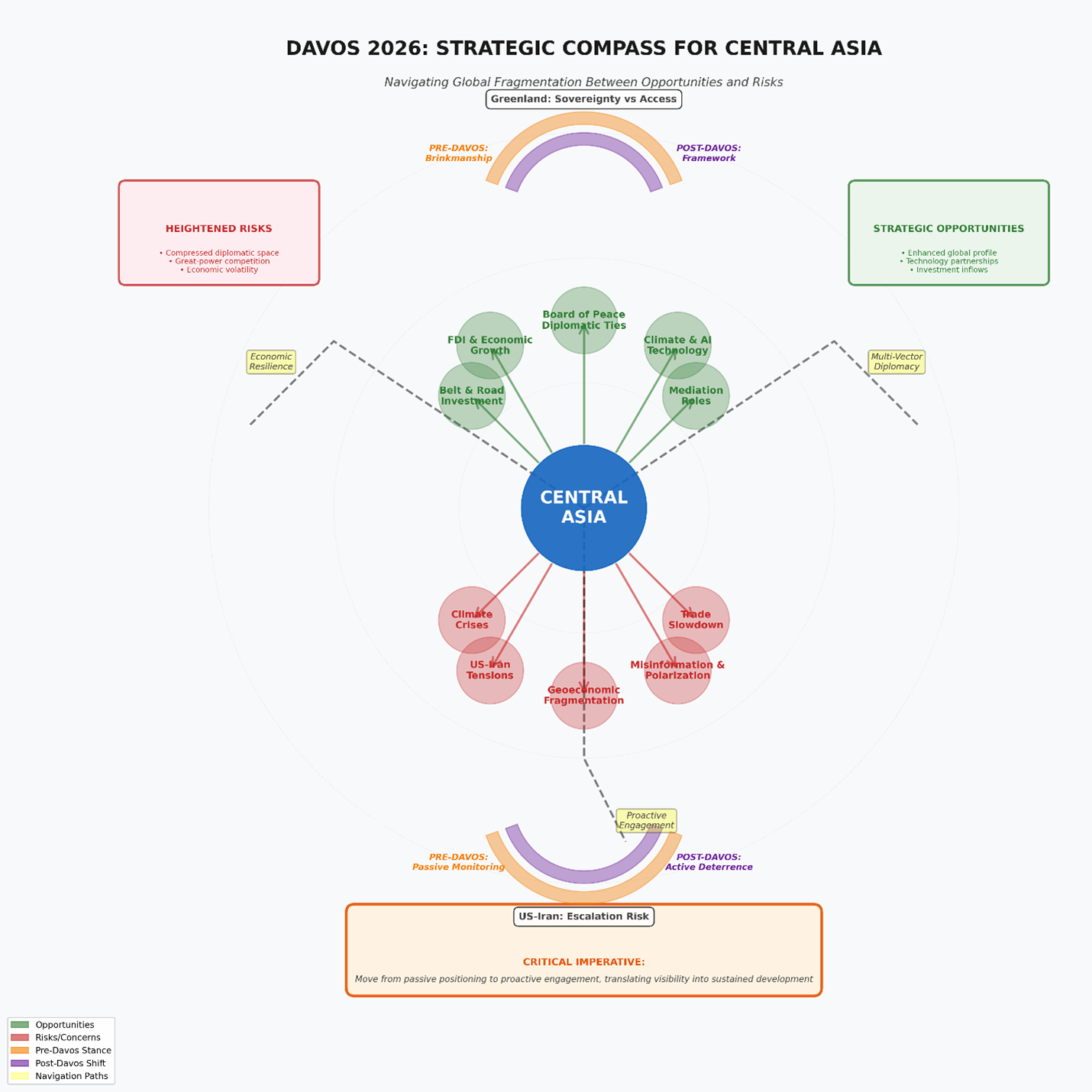
Davos 2026 presents Central Asia with a complex landscape of strategic opportunities and heightened risks that demand careful navigation.
The region’s participation through the Board of Peace initiative and engagement on climate and economic issues signals growing diplomatic maturity, yet the forum’s outcomes underscore deepening global fragmentation that could strain Central Asia’s multi-vector foreign policy. /// nCa, 24 January 2026