


Imagine a gigantic ocean that once stretched from what is now the Mediterranean Sea all the way to the distant corners of Asia. This was the Tethys Ocean — a vast body of water that separated ancient continents. Today, only the Mediterranean remains as its remnant, but its influence on Earth’s landscape has proven far more enduring than one might expect. A new study by researchers from the University of Adelaide (Australia) reveals that it was precisely the dynamics of this ancient ocean — rather than solely the collision between India and Eurasia — that shaped the relief of Central Asia during the Cretaceous period, the age of dinosaurs.
We usually associate the formation of mountain ranges with powerful tectonic forces: colliding plates, mantle material pushing up the crust from below, or climate changes that accelerate erosion. But Dr. Sam Boone (a postdoctoral researcher at Adelaide University at the time of the study) and his colleagues reached a surprising conclusion. After analyzing hundreds of thermal history models of Central Asian rocks, accumulated over three decades of research, they found that climatic changes and mantle processes played only a minor role.
“We found that climate change and mantle processes had only little influence on the Central Asian landscape, which persisted in an arid climate for much of the last 250 million years,” said Dr. Sam Boone. “Instead, the dynamics of the distant Tethys Ocean can directly be correlated with short-lived periods of mountain building in Central Asia.”
The Tethys Ocean began to close during the Mesozoic and Cenozoic eras (the last 250 million years). Its disappearance was uneven: oceanic crust subducted beneath continents, plates “rolled back,” causing extension and reactivation of old faults. These processes “awakened” ancient suture zones — the scars of previous continental collisions — across enormous distances from the main subduction front.
“The present-day relief of Central Asia was largely built by the India-Eurasia collision and ongoing convergence,” said co-author Associate Professor Stijn Glorie, from Adelaide University’s School of Physics, Chemistry and Earth Sciences. “It is thought that the extension in the Tethys, due to rollback of subducting slabs of ocean crust, reactivated old suture zones into a series of roughly parallel ridges in Central Asia, up to thousands of kilometers away from the Himalaya collision zone.”
What traces of Tethys remain in present-day Central Asia and surrounding regions? Striking evidence can be seen right in Turkmenistan.
In Lebap province, on the Pitnyak Upland (once part of the ancient Tethys seafloor), the cliffs are literally covered with fossils: sea urchins, mollusks with a wide variety of ribbed shells, and teeth of ancient sharks. These places were once shallow waters of a huge ocean — and now they tell the story of rich Mesozoic marine life.
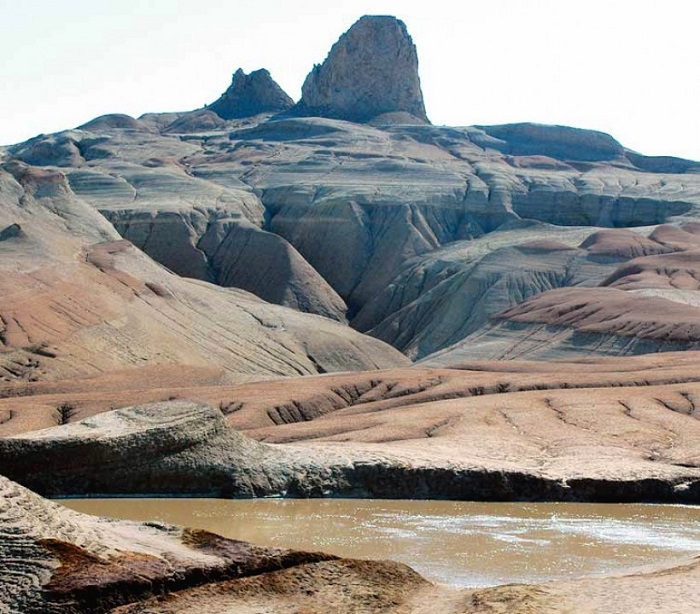
An even more impressive legacy lies in western Turkmenistan, in Balkan province: the famous mud volcanoes, among the most notable being Akpatlavuk and Gökpatlavuk. These “earth hills” erupt not lava, but a mixture of mud, gas, and water. Scientists link their formation to the shrinkage of the Tethys in this region about 10–12 million years ago. As the ocean retreated, thick sedimentary layers were compressed, forcing gases and fluids upward and giving birth to these unusual geological monuments. Akpatlavuk, for example, rises between 60 and 80 meters, and a lake sits in its crater, fed by gas-mud springs.
The University of Adelaide study reminds us that even vanished oceans continue to shape our world. Their “final breaths” — subduction, slab rollback, fault reactivation — built the mountains that dinosaurs once gazed upon millions of years ago and that we see today. /// nCa, 16 January 2026