


nCa Report
Key Points
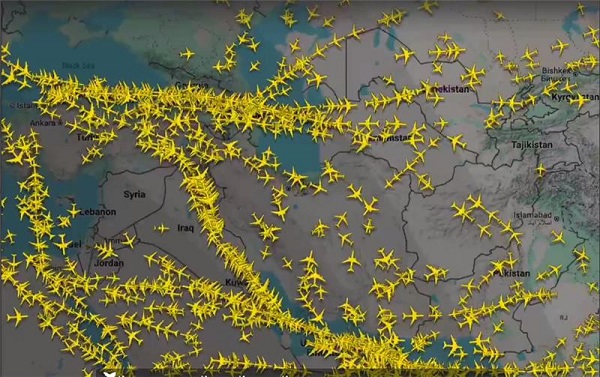
- Research suggests that as of early 2026, Iran’s airspace is fully operational following partial reopenings in mid-2025, handling approximately 1,000–1,400 daily overflights in stable periods, though traffic volumes have fluctuated due to lingering risks from the 2025 Israel-Iran conflict.
- It seems likely that major directions include east-west corridors linking Europe to Asia and north-south flows between the Middle East and Central Asia, with key countries like the UK, Germany, UAE, Qatar, India, and Kazakhstan involved, but evidence points to reduced volumes during 2025 disruptions.
- The evidence leans toward Iran earning around $2–2.5 million daily from overflight fees pre-conflict, primarily from civilian flights, with non-civilian operations potentially exempt; however, 2025 closures likely caused significant revenue losses.
- In cases of unavailability, traffic diverts to northern routes via Turkey and the Caspian Sea, southern via Egypt and Saudi Arabia, or central via Iraq, often adding 45–120 minutes, extra fuel costs of $5,000–14,000 per flight, and potentially higher fees, contributing to global aviation losses estimated at $5–15 million daily during closures.
- For Middle East-Central Asia traffic, volumes appear modest at 20–40 daily flights, with similar diversion impacts, highlighting regional connectivity vulnerabilities amid geopolitical tensions.
Overview of Traffic and Revenue
Iran’s airspace serves as a vital link for global aviation, but the 2025 conflict introduced uncertainties. Current estimates indicate recovery toward pre-conflict levels, with fees supporting infrastructure. For details, see sources like Safe Airspace and OPS Group.
Diversion Implications
Diversions during closures reroute flights, increasing operational costs. Northern and southern paths are common, with fuel and time penalties varying by route. Airlines like Emirates and Lufthansa have adapted, but prolonged issues could raise fares.
Regional Focus: Middle East-Central Asia
This segment, though smaller, underscores economic ties, with Gulf hubs connecting to Kazakh and Uzbek cities. Diversions add comparable burdens, as seen in 2025 surges over Afghanistan.
* * *
Iran’s airspace remains a critical corridor in international aviation, bridging Europe, the Middle East, Asia, and beyond, despite the disruptions from the 2025 Israel-Iran conflict. As of early 2026, following reopenings in mid-2025, the airspace is fully operational, but operators continue to monitor risks from potential military activities and air defense systems.
This report integrates general air traffic patterns, including east-west and north-south flows, with specific details on Middle East-Central Asia connectivity. It draws on aviation tracking data, industry reports, and official advisories to assess volumes, revenues, and the economic fallout from unavailability scenarios.
Pre-2025 estimates placed daily overflights at 1,000–1,400, a figure that aligns with recoveries post-ceasefire, though 2025 saw sharp declines with closures affecting up to 75% of monthly traffic. Directions primarily encompass east-west transits from European nations (e.g., UK, Germany, France) to South and Southeast Asia (e.g., India, Thailand, Singapore), often via Gulf hubs like Dubai and Doha, as well as north-south routes linking the Middle East to Central Asia.
Key originating countries include the UK (British Airways), Germany (Lufthansa), France (Air France), UAE (Emirates, Etihad, FlyDubai), Qatar (Qatar Airways), India (Air India, IndiGo), Singapore (Singapore Airlines), Japan (Japan Airlines), and for Central Asia segments, Kazakhstan (Air Astana) and Uzbekistan (Uzbekistan Airways).
Focusing on the Middle East-Central Asia corridor, traffic averages 20–40 daily flights, representing a growing but minor portion of Iran’s total overflights. These are mainly northbound from Gulf states (UAE, Qatar, Saudi Arabia) to Central Asian hubs like Almaty, Astana (Kazakhstan), and Tashkent (Uzbekistan), driven by business, tourism, and migration.
Examples include 3–5 daily Dubai-Almaty flights by flydubai and Air Astana, 3 daily Dubai-Astana, and 3 daily Dubai-Tashkent, with additional services from Doha and Jeddah adding 5–10 more. Annual growth of 10–20% pre-conflict reflects strengthened ties, but 2025 disruptions highlighted vulnerabilities.
Revenue from airspace usage is a key economic driver for Iran, with pre-2025 annual figures around $800 million from overflight fees, equating to $2–2.5 million daily based on 1,000–1,400 flights at $800–2,200 each (factored by aircraft weight and distance). Civilian flights dominate, while non-civilian (military) ones are often exempt or under separate agreements, contributing minimally.
For the Middle East-Central Asia segment, daily revenue is estimated at $100,000–200,000 from 100–200 partial overflights. The 2025 conflict caused substantial losses, with Iran’s overall aviation sector declining nearly 10% in flights and facing broader economic pressures like inflation and sanctions.
In temporary unavailability scenarios—short-term (days) or prolonged (weeks)—traffic redirects to three main routes: northern via Turkey, Azerbaijan, Turkmenistan, and the Caspian Sea; southern via Egypt and Saudi Arabia; and central via Iraq and Turkey, though the latter is often restricted.
For Middle East-Central Asia, alternatives include eastern paths via Pakistan and Afghanistan (despite risks) or northern Caspian routes. These diversions add 45–120 minutes per flight, with examples like London-Hong Kong extending by 2 hours or Dubai-Almaty by 45–90 minutes. Extra fuel costs range from $5,000–14,000 per flight for long-haul aircraft like Boeing 777s (at $7,000/hour, based on 7–10 tons/hour burn and $800/ton fuel prices).
Additional fees vary—e.g., $450–700 in Iraq, $700 in Afghanistan, potentially exceeding Iran’s rates by $200–500 aggregate. Global daily losses during 2025 closures reached $5–15 million, factoring in fuel, crew, maintenance, and delays, with Middle East-Central Asia adding $100,000–400,000. Prolonged disruptions could increase fares by 5–15%, strain alternative corridors (e.g., Saudi overflights doubling), and reduce cargo efficiency.
To illustrate general route impacts:
| Route Example | Normal Path (via Iran) | Alternative Path | Extra Time | Estimated Extra Fuel Cost (per Flight) | Additional Fees Insight |
| London to Dubai | Over Iraq/Iran | South via Egypt/Saudi | 45–60 min | $5,000–7,000 | Egypt/Saudi ~$400–600, comparable to Iran |
| Frankfurt to Mumbai | Direct over Iran | North via Turkey/Azerbaijan/Caspian | 60–90 min | $7,000–10,000 | Turkey/Azerbaijan ~$500–800, potentially higher |
| Paris to Bangkok | Via Iran/Pakistan | South via Egypt/Saudi or North via Caspian | 90–120 min | $10,000–14,000 | Multi-country fees add $300–700 over Iran’s rate |
| Dubai to New York (via Europe) | West over Iran | North via Turkey or South detour | 60–90 min | $7,000–10,000 | Iraq/Turkey $450–700 vs. Iran’s $800–2,000 |
For Middle East-Central Asia specifics:
| Route Example | Normal Path (via Iran) | Alternative Path | Extra Time | Estimated Extra Fuel Cost (per Flight) | Additional Fees Insight |
| Dubai to Almaty | Over Iran | East via Pakistan-Afghanistan or North via Caspian | 45–90 min | $5,000–10,000 | Pakistan/Afghanistan ~$400–600, risk-adjusted |
| Doha to Tashkent | Direct over Iran | North via Turkey-Azerbaijan | 60–90 min | $7,000–10,000 | Azerbaijan/Turkmenistan ~$500–800 aggregate |
| Abu Dhabi to Astana | Via Iran | East or North detour | 45–75 min | $5,000–8,000 | Multi-country fees add $200–500 over Iran’s |
These tables reflect 2025 observations and post-conflict adaptations, emphasizing the need for resilient routing in a volatile region. Overall, while recovery is underway, Iran’s airspace unavailability amplifies global costs and underscores diversification strategies. /// nCa, 7 January 2026
Key Citations
- Safe Airspace – Conflict Zone and Risk Database
- Escalating crises are redrawing the air map of the world – CNN
- Middle East conflict adds to the global airspace squeeze – Travel Weekly
- Is it safe to over fly the Iranian airspace? – Icarus Jet
- Airlines pay the price as no-go airspace increases – The Guardian
- Airlines face fresh upheaval as Iran attacks – Reuters
- Global airlines continue avoiding Middle East airspace – IntelliNews
- US Strikes on Iran Add to Global Travel Disruptions – DTN
- Borders closing and airspace shut – Al Jazeera
- Aviation Alerts and Advisories in West Asia – SafeFly
- Middle East: Land, Air, and Maritime Travel Disruptions – Crisis24
- Middle East disruption ripples through MENA-Asia trade lanes – Air Cargo Week
- Dodging Danger: The Three Routes Through the Middle East – OPS Group
- Airlines are circumventing Iranian airspace – Travel Weekly
- Airspace of the Middle East – EASA
- Israel’s main airport receives passenger boost – Reuters
- Airspace over Iran, Iraq, and Israel Closed – AIN Online
- Flying in the new age of conflict – The Guardian
- Major Airspace Closures In Middle East – Globe Aware
- Airlines Avoiding Iran: Where Are They Flying Now? – Simple Flying
- Iran: As of June 26, 2025 – Facebook (TravelGov)
- Airlines suspend routes, reroute flights – Travel Trade Journal
- Middle East airspace shut – Reuters
- Here’s How Middle East Conflict Impacts Travel – Indian Eagle
- Over 1400 Planes Crossing Iran’s Sky Every Day – IFP News
- Iran – Safe Airspace
- Iran Reopens Most Airports – Aurantius
- Number of passing flights thru Iran’s airspace – IRNA
- Iran’s airspace closure (June 2025) – X (AirlinePilotmax)
- Iran Reopens Airspace – Caspian Post
- Israel-Iran strikes – Al Arabiya
- Global airlines continue avoiding Middle East airspace – IntelliNews
- Turbulent skies: How Israel-Iran tension is disrupting global aviation – Mehran Haghirian
- Kabul profits from rerouted flights – AGBI
- Aerial crisis: Iraq losing millions – Shafaq
- As Ukraine, Gaza wars rage on – Al Jazeera
- Israel’s Iran attacks deliver double hit – The National
- Afghan airspace sees surge – Ariana News
- Iran has modified its airspace restrictions – Facebook (Flightradar24)
- Airlines are circumventing Iranian airspace – Travel Weekly
- A flight tracker shows airlines avoiding – Facebook (TheIndependentOnline)
- Flightradar24 Live Airspace in the Middle East – YouTube
- Flight tracker shows airlines avoiding – AOL
- Flights clearing Iran and Iraq – Facebook (Flightradar24)
- Flightradar24 | Iran has partially reopened – Instagram
- Airports in Iran – Flightradar24
- What World’s Air Traffic Looks Like – NDTV
- flightradar24 – Instagram