


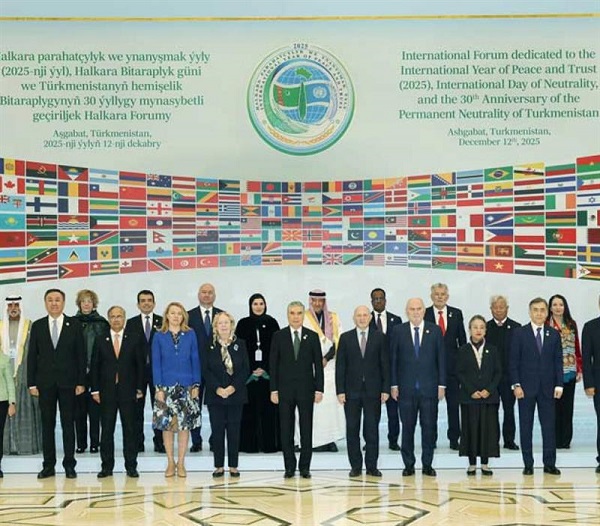
Delegations from international and regional structures participated in the International Forum held in Ashgabat, timed to coincide with the International Year of Peace and Trust, the International Day of Neutrality, and the 30th anniversary of Turkmenistan’s permanent neutrality.
After the plenary session featuring speeches by heads of state and government, the forum continued under the chairmanship of the National Leader of Turkmenistan, Gurbanguly Berdimuhamedov.
In this part of the forum, the following speakers took the floor:
- Gurbanguly Berdimuhamedov — National Leader of the Turkmen people, Chairman of the Halk Maslahaty (opened the session and delivered the keynote speech).
- Tatiana Valovaya — Deputy Secretary-General of the United Nations, Director-General of the United Nations Office at Geneva.
- Kaha Imnadze — Special Representative of the UN Secretary-General for Central Asia, Head of the United Nations Regional Centre for Preventive Diplomacy for Central Asia.
- Feridun Sinirlioğlu — Secretary General of the Organization for Security and Co-operation in Europe (OSCE).
- Asad Majid Khan — Secretary General of the Economic Cooperation Organization (ECO).
- Tatiana Molchan — Deputy Secretary-General of the United Nations, Executive Secretary of the United Nations Economic Commission for Europe.
- Armida Salsiah Alisjahbana — Deputy Secretary-General of the United Nations, Executive Secretary of the United Nations Economic and Social Commission for Asia and the Pacific (ESCAP).
- Nurlan Yermekbayev — Secretary General of the Shanghai Cooperation Organisation (SCO).
- Xu Haoliang — Deputy Secretary-General of the United Nations, Associate Administrator of the United Nations Development Programme (UNDP).
- Xing Qu — Deputy Director-General of UNESCO.
- Salim Al Malik — Director General of the Islamic World Educational, Scientific and Cultural Organization (ICESCO).
Welcoming the participants and guests of the Forum, the National Leader of Turkmenistan delivered a keynote speech, noting that “for Turkmenistan, neutrality is not just a model of foreign policy. It is the foundation of our worldview, our self-perception of the role and responsibility as a state and a people, […] our neutrality is unchanging, not subject to external conjuncture or temporary, situational factors. Turkmenistan strictly aligns and will continue to align all its approaches to global, regional, and bilateral agenda issues, as well as all its initiatives and practical actions, with the status of permanent neutrality.”
“Much remains to be done jointly to improve the international situation, restore trust and the culture of political dialogue,” said Berdimuhamedov, emphasizing that the Forum is an important step in this direction.
Deputy Secretary-General of the United Nations and Director-General of the United Nations Office at Geneva Tatiana Valovaya congratulated President of Turkmenistan Serdar Berdimuhamedov, National Leader Gurbanguly Berdimuhamedov, and the entire Turkmen people on the 30th anniversary of the country’s permanent neutrality — the historic date of December 12, 1995, when the UN General Assembly officially recognized this status.
She noted that in October 2025, with the support of Turkmenistan’s Permanent Mission, a meeting dedicated to issues of peace, security, and neutrality was held in Geneva, which once again confirmed the relevance of the principles of dialogue and trust in the modern world.
Tatiana Valovaya highlighted Turkmenistan’s significant initiatives in 2025 — the International Year of Peace and Trust — aimed at achieving the Sustainable Development Goals (SDGs). In her words, the global Agenda for Sustainable Development serves as a roadmap for eliminating the causes of misunderstanding and ensuring peace and stability.
In conclusion, she stated that the current forum takes on special significance as a platform for exchanging experience, best practices, and promoting peace, stability, and the SDGs. Turkmenistan’s geographical position and commitment to neutrality allow it to act as a reliable partner connecting peoples, countries, and cultures, actively contributing to the establishment of peace.
Special Representative of the UN Secretary-General for Central Asia and Head of the United Nations Regional Centre for Preventive Diplomacy for Central Asia Kaha Imnadze emphasized in his speech the historic significance of the official recognition on December 12, 1995, by the UN General Assembly of Turkmenistan’s permanent neutrality status. This event, in his words, strengthened the legal foundation of neutrality on the international arena and vividly demonstrated the importance of the Turkmen model in international law and interregional relations.
Imnadze described Turkmenistan’s neutrality as an effective mechanism aimed at strengthening dialogue, mutual respect, and good-neighborly relations, as well as maintaining regional stability. This unique status promotes productive interaction with neighbors and international partners.
He particularly highlighted the joint preventive diplomacy efforts of Turkmenistan and the UN Regional Centre in Ashgabat, which have created a reliable platform for building trust among regional states and joint actions to combat climate change and other contemporary challenges.
Imnadze cited the recent Third United Nations Conference on Landlocked Developing Countries in Avaza and the adoption of the Avaza Political Declaration as evidence of Turkmenistan’s successes in sustainable development and international cooperation. He also noted Turkmenistan’s promotion of large-scale infrastructure, transit, and energy initiatives that contribute to integration processes in the region.
In conclusion, Kaha Imnadze stated that the United Nations and other international structures emphasize that peace is achieved through dialogue and trust, and the role of neutral states, including Turkmenistan, in promoting successful cooperation and constructive dialogue is becoming increasingly important. He confirmed the UN’s readiness to cooperate on the forum’s initiatives, including the proposal to establish a University of Peace and Neutrality.
Secretary General of the Organization for Security and Co-operation in Europe (OSCE) Feridun Sinirlioğlu noted in his speech that it is a great honor for him to represent the OSCE at the Forum dedicated to the International Year of Peace and Trust.
He emphasized that during his first visit to Central Asia, he is particularly pleased to participate in the celebrations marking the 30th anniversary of Turkmenistan’s permanent neutrality. In his words, the current Forum vividly demonstrates Turkmenistan’s commitment to intensifying international dialogue on key issues of global peace and security.
Feridun Sinirlioğlu stated that the OSCE fully supports Turkmenistan’s efforts in this direction. He recalled that since 1992, Turkmenistan has been an important partner of the OSCE and fruitfully cooperates with its Center in Ashgabat.
Secretary General of the Economic Cooperation Organization (ECO) Asad Majid Khan emphasized that the model of permanent neutrality chosen by Turkmenistan is based on the principles of respect for the sovereignty of states, non-interference in their internal affairs, and strengthening partnership relations with all countries.
Turkmenistan’s positive neutrality is aimed at promoting goodwill and effective cooperation. This concept reflects the country’s strategic vision and is a priority direction of national foreign policy, successfully implemented under the leadership of President Serdar Berdimuhamedov, who continues the initiatives of the National Leader of the Turkmen people.
Deputy Secretary-General of the United Nations, Executive Secretary of the United Nations Economic Commission for Europe Tatiana Molchan focused attention on the work within the framework of the United Nations Special Programme for the Economies of Central Asia (SPECA), aimed at developing regional cooperation.
Tatiana Molchan particularly highlighted an important direction of the Programme — the creation of a sustainable transport system and facilitation of trade, which is an integral part of implementing the 2030 Agenda for Sustainable Development. In her words, despite the technical nature of these tasks, they create the foundation for building peace and cooperation on priority regional issues, including combating climate change, water-related topics, and exchanging experience in technological achievements.
In conclusion, she noted that implementing the SPECA Programme will contribute to the effective use of regional potential to create a prosperous, sustainable, and just living environment.
Deputy Secretary-General of the United Nations, Executive Secretary of the United Nations Economic and Social Commission for Asia and the Pacific (ESCAP) Armida Salsiah Alisjahbana emphasized that by organizing such an important Forum, Turkmenistan confirms its commitment to multilateral cooperation and the consolidation of regional efforts to achieve the Sustainable Development Goals.
She noted that the Third United Nations Conference on Landlocked Developing Countries became an important step in implementing the 2030 Agenda.
The UN Deputy Secretary-General paid special attention to the fact that neutrality is an effective instrument in strengthening friendship, mutual trust, global peace, and security.
Expressing gratitude for the speech, Gurbanguly Berdimuhamedov expressed confidence that bilateral cooperation with ESCAP will contribute to peace, well-being, and sustainable development of the countries in the region.
SCO Secretary-General Nurlan Yermekbayev in his speech recalled that the Tianjin Declaration of the Council of Heads of State adopted on September 1, 2025, confirmed the readiness of SCO member states to act in accordance with the “Shanghai Spirit,” emphasizing that its goals and tasks largely resonate with the noble principles of neutrality, the main ones being openness to broad partnership, receptivity to positive global experience, and an active peace-loving position in resolving regional and global problems.
Deputy Secretary-General of the United Nations, Associate Administrator of the United Nations Development Programme (UNDP) Xu Haoliang noted that UNDP attaches great importance to joint cooperation with Turkmenistan in key areas: healthcare, digitalization, combating climate change, and implementing a “green” economy.
Xu Haoliang noted that in recent years, the partnership between UNDP and Turkmenistan has reached a qualitatively new level.
Deputy Director-General of the United Nations Educational, Scientific and Cultural Organization (UNESCO) Xing Qu emphasized that since Turkmenistan joined UNESCO, a number of its cultural and historical values have been included in the Lists of Tangible and Intangible Cultural Heritage of Humanity. In particular, Xing Qu noted that at the recent session of the UNESCO Intergovernmental Committee for the Safeguarding of Intangible Cultural Heritage in New Delhi, a decision was made to include the nomination “The Art of Breeding Turkmen Alabay” proposed by Turkmenistan in the Representative List, and congratulated on this event.
In addition, he mentioned the effective nature of bilateral cooperation: in 2023, Ashgabat was included in the UNESCO Creative Cities Network in the “Design” category, and a number of general education schools in Turkmenistan — in the UNESCO Associated Schools Network.
Xing Qu stated that the views and positions voiced at the Forum are inextricably linked with UNESCO values, especially in terms of developing interaction in education for peace. He emphasized that Turkmenistan’s efforts to promote peaceful dialogue based on considering opinions and trust receive broad support from UNESCO.
Director General of the Islamic Educational, Scientific and Cultural Organization (ICESCO) Salim Al Malik emphasized that Turkmenistan, thanks to the far-sighted policy of the National Leader of the Turkmen people Gurbanguly Berdimuhamedov and President Serdar Berdimuhamedov, is known worldwide for its unique national cultural heritage and enriches the concept of peace and trust with new content.
The speaker noted that Turkmenistan’s successfully implemented policy of positive neutrality finds broad support and recognition on the international arena. In this context, the Forum of Peace and Trust has enormous significance for uniting efforts to thoughtfully address pressing global issues.
Mutual trust and openness are values that strengthen cooperation; by adhering to them, Turkmenistan demonstrates an exemplary model in maintaining peace and trust on the planet, said Salim Al Malik. Trust is the path leading to peace, and where there is peace, there is well-being and prosperity.
Arkadag Berdimuhamedov Summarizes the Forum
In his concluding speech, the National Leader of the Turkmen people, Chairman of the Halk Maslahaty Gurbanguly Berdimuhamedov, summarized the International Forum:
He noted that during the session, the most important ideas, concepts, high assessments, and proposals were voiced, which will undoubtedly find support and understanding and will be applied in practical political-diplomatic work, cooperation, and partnership interaction among states, as well as in the activities of international organizations.
The distinctive feature of the Forum, in his words, was the openness of participants and their readiness for joint search for solutions to key contemporary issues, the ability to perceive different points of view and respectfully treat the arguments and positions of the parties. This is precisely the value of dialogue as the most promising and, possibly, the only path to truly significant results, balancing interests, and constructive compromises.
The Forum set correct, viable geopolitical and economic vectors for the long term; its content and messages are oriented toward the future and focused on broad horizons of strategic planning, priority setting, and systematic analysis of global trends.
Gurbanguly Berdimuhamedov emphasized that the speeches and exchange of opinions demonstrated a common understanding of the main, objective, and indisputable reality — the need to create a holistic, indivisible system of security and development that meets the genuine interests of all peoples on the planet. This is possible only with goodwill, mutual trust, and high responsibility for the fate of the world. It was these principles that dictated the initiative to declare 2025 the “International Year of Peace and Trust.”
The Forum confirmed that the values “Peace and Trust” are gaining more supporters, becoming not abstract concepts but real and effective factors of global development, a moral support and driving force for constructive interaction and cooperation. Although much remains to be done to establish and consolidate these principles in consciousness and political practice, the chosen path is correct.
The National Leader expressed conviction that the Ashgabat Forum and the creative impulses it generated will serve further fruitful joint work and yield visible results in the interests of peace and human progress.
The forum concluded with the adoption of the Ashgabat Declaration. ///nCa, 13 December 2025