


Turkmenistan’s Neutrality as a Catalyst for Regional and Global Integration
Tariq Saeedi and Elvira Kadyrova
The Neutrality Advantage: A Unique Convening Power
Turkmenistan’s 30-year commitment to permanent neutrality, internationally recognized by the UN in 1995, 2015, and 2025, has created a distinctive diplomatic asset: the ability to bring together nations that might otherwise struggle to meet on neutral ground.
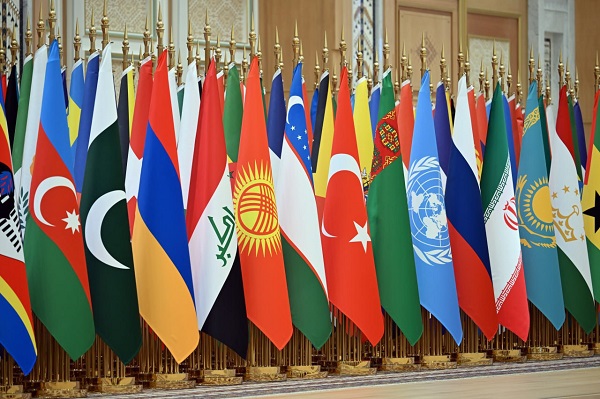
The December 2025 forum in Ashgabat demonstrated this convening power in unprecedented ways, assembling leaders from Russia, Iran, Turkey, and Central Asian nations alongside representatives from Armenia, Azerbaijan, Georgia, Iraq, Pakistan, Myanmar, and Sao Tome and Principe—a geographic span from the South Caucasus to Southeast Asia, from the Middle East to Africa.
This gathering reveals that neutrality is not passive isolation but active engagement—a platform where competing interests can find common ground and where regional rivals can explore cooperative frameworks without compromising their own strategic positions.
Transportation: Weaving Continental Connectivity
The forum proposals paint a picture of Eurasia transformed into an integrated transportation network, with Turkmenistan serving as a critical node:
The North-South Corridor (Russia’s proposal) would connect the Indian subcontinent through Iran and the Caspian region to Russia and Northern Europe. Combined with multimodal transport routes championed by Kyrgyzstan and the China-Kyrgyzstan-Uzbekistan Railway, the region would possess multiple transcontinental arteries moving goods and people efficiently across previously fragmented zones.
Projected Gains:
- Economic Impact: Reduced transportation costs by 30-40% compared to current routes through the Suez Canal
- Time Efficiency: Transit times from South Asia to Europe cut from 45-60 days to 20-25 days
- Trade Volume: Potential doubling of intra-regional trade within 10 years of full implementation
- Employment: Hundreds of thousands of jobs in logistics, infrastructure maintenance, and border services
- Market Access: Landlocked Central Asian nations gain direct access to Persian Gulf and Arabian Sea ports
When Pakistan (present through Prime Minister Sharif) is factored into this network, the transportation web extends to South Asia’s 1.8 billion people. Myanmar’s presence (Prime Minister New SO) hints at potential eastern extensions toward ASEAN markets. This is not merely regional integration—it is the foundation of a new Eurasian economic geography.
Water: From Crisis to Cooperation
Water emerged as perhaps the most urgent arena for cooperation, with three major proposals converging:
Kazakhstan’s International Water Organization would provide the institutional framework for what Tajikistan and Turkmenistan have long advocated: systematic management of transboundary water resources. The revitalized International Fund for Saving the Aral Sea (highlighted by Uzbekistan) would address one of the world’s greatest ecological disasters, while Iran’s emphasis on water inequality connects Central Asian concerns to broader Middle Eastern water security challenges.
Projected Gains:
- Environmental Restoration: Coordinated Aral Sea rehabilitation could restore 20-30% of the sea’s historical volume within two decades
- Agricultural Productivity: Scientific water allocation could increase regional agricultural output by 15-20% while using 25% less water
- Conflict Prevention: Institutionalized water-sharing mechanisms would eliminate potential flashpoints for future “water wars”
- Climate Resilience: Regional cooperation on glacier monitoring and water storage would help 80+ million people adapt to climate change
- Energy Security: Coordinated hydropower development (like Kyrgyzstan’s Kambarata HPP-1) balanced with downstream water needs
- Economic Value: Estimated $50-70 billion in agricultural, energy, and ecosystem services gains over 20 years
The Caspian Sea issues, mentioned by both Kazakhstan and Russia, add another layer: five littoral states (Russia, Kazakhstan, Turkmenistan, Iran, and Azerbaijan—represented at the forum) managing shared maritime resources and environmental challenges.
Economic Integration: Beyond Trade Agreements
The economic integration emerging from these proposals transcends traditional free trade agreements:
Energy Cooperation forms a core pillar, with Turkmenistan’s vast gas reserves (fourth-largest globally) positioned to supply energy-deficient neighbors through new pipelines and electricity grids. Russia’s 35% trade growth with Turkmenistan in just 10 months demonstrates the velocity of economic deepening possible under neutral facilitation.
Investment Flows would multiply as infrastructure projects create new opportunities. Turkey’s emphasis on investments, trade, and energy cooperation suggests Ankara positioning itself as a bridge between Europe and Central Asia, while Russia’s mention of “new investment projects” indicates sustained capital deployment.
Projected Gains:
- Regional GDP Growth: Estimated 2-3% additional annual GDP growth across Central Asia from enhanced connectivity and trade
- Foreign Direct Investment: Potential tripling of FDI flows into the region within 5 years
- Energy Security: Diversified supply routes reducing vulnerability to single-source dependencies
- Technology Transfer: Infrastructure projects bringing advanced technologies and skills to the region
- Market Integration: A potential common market of 400+ million people from Turkey to Central Asia
- Poverty Reduction: World Bank estimates suggest such integration could lift 15-20 million people out of poverty
Preventive Diplomacy: Neutrality as Conflict Prevention Architecture
The soft power dimensions deserve equal attention. Uzbekistan’s Year of Preventive Diplomacy 2027 under the Non-Aligned Movement chairmanship, combined with Turkmenistan’s proposed UN University of Peace and Neutrality, would institutionalize conflict prevention as a regional and global practice.
Projected Gains:
- Conflict Prevention: Early warning systems and diplomatic mechanisms reducing risk of interstate conflicts
- Mediation Capacity: Trained diplomats and scholars specializing in neutral mediation
- Cultural Understanding: The “Dialogue of Cultures” forum (Uzbekistan, 2026) promoting mutual understanding
- Youth Engagement: Regional “Youth for Peace and Trust” program creating next-generation peace advocates
- Norm Diffusion: Neutrality principles spreading through education and diplomatic practice
The True Geography: From Heart of Asia to Global Reach
While the analyzed speeches came from leaders of Russia, Turkey, Iran, and five Central Asian nations, the forum’s actual geographic footprint was far more extensive:
South Caucasus: Presidents of Armenia and Prime Minister of Azerbaijan—nations technically still in conflict—both present, suggesting Turkmenistan’s neutral ground as a possible venue for confidence-building
Middle East: Presidents of Iraq and Iran, representing two major regional powers navigating complex relationships
South Asia: Pakistan’s Prime Minister, connecting Central Asia to South Asian markets and concerns
Southeast Asia: Myanmar’s Prime Minister, representing ASEAN’s potential connection to Eurasian integration
Africa: Sao Tome and Principe’s President, indicating that neutrality diplomacy resonates beyond the immediate region
Additionally: Prime Minister of Georgia and Prime Minister of Eswatini, plus numerous lower-level delegations
This geographic spread—from the Atlantic coast of Africa to Southeast Asian archipelagos—reveals that Turkmenistan’s neutrality forum has become a truly global convening platform. The immediate operational geography centers on the Caspian-Central Asian-Iranian-Turkish-Russian space (roughly 350 million people, $3+ trillion combined GDP), but the forum’s influence extends to shaping norms and practices across the entire Eurasian landmass and beyond.
What This Means for the Rest of the World
For Europe: Alternative trade routes to Asia that bypass geopolitical chokepoints; energy diversification through Central Asian supplies
For China: Validation of Belt and Road Initiative concepts through multilateral regional cooperation; secure western borders
For South Asia: Integration into Eurasian economy; Afghanistan stabilization through regional economic inclusion (mentioned by multiple speakers)
For the Middle East: Connection of Arabian Peninsula and Levant economies to Central Asian markets; water management models
For Africa: Demonstration that neutral diplomacy can facilitate South-South cooperation; potential model for African Union initiatives
For Global Governance: Testing ground for UN reform ideas; practical implementation of preventive diplomacy; alternative to Western-dominated or China-led frameworks
The Compounding Effect: Synergies Across Sectors
The true transformative potential lies in how these initiatives reinforce each other:
- Transportation infrastructure makes energy cooperation more viable (pipelines follow railways)
- Water agreements build trust that facilitates political dialogue on harder issues
- Economic integration creates stakeholders invested in conflict prevention
- Educational exchanges (54,000 Turkmen students in Russia alone) create long-term cultural ties
- Institutional frameworks (UN University, Water Organization) provide permanent mechanisms for addressing new challenges
When all proposed initiatives are implemented, the region transforms from a patchwork of post-Soviet states with limited connectivity into an integrated economic zone with robust institutions, shared infrastructure, and cultures of dialogue—all anchored by Turkmenistan’s neutrality principle.
The Neutrality Premium: Measurable Benefits
Turkmenistan’s neutral status delivers concrete advantages that enable this integration:
- Trust Differential: No country fears Turkmenistan’s territorial ambitions or political interference
- Diplomatic Access: Can engage simultaneously with Iran and Western powers, Russia and Turkey, China and India
- Institutional Hosting: Can house regional organizations without sovereignty concerns
- Mediation Capacity: Credible as honest broker in disputes
- Economic Attractiveness: Neutrality reduces investment risk and attracts diverse partnerships
This “neutrality premium” is what transforms Ashgabat from a capital city into a platform—a space where the geopolitically impossible becomes diplomatically achievable. The forum’s outcomes suggest this premium is appreciating, not depreciating, in value as global polarization increases. /// nCa, 13 December 2025