


Elvira Kadyrova at Awaza, Liliya Zhirnova in Ashgabat
AVAZA, Turkmenistan — Against the backdrop of the Caspian Sea’s turquoise waters, the resort town of Avaza is hosting an international conference that brings together government ministers, foundation leaders, and civil society representatives from across continents.
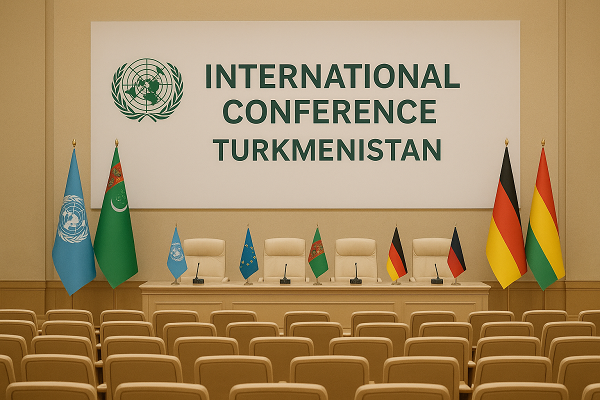
The two-day gathering, focused on “The Role of Women in Modern Society: Developing International Cooperation to Achieve the Sustainable Development Goals,” opens Tuesday as part of Turkmenistan’s broader celebrations marking three decades of its constitutionally enshrined permanent neutrality.
The conference represents more than a diplomatic gathering—it serves as a window into how Turkmenistan interprets its unique status in global affairs. By centering discussions on gender equality, social protection, and sustainable development, the host nation is articulating a vision of neutrality that extends beyond military non-alignment to encompass humanitarian principles and social progress.
The event’s timing and scope suggest a deliberate effort to demonstrate that neutrality, far from meaning isolation, can serve as a platform for international cooperation on issues of universal concern.
The roster of arriving delegations reflects both geographic diversity and thematic focus. From Azerbaijan came Leyla Aliyeva, Vice President of the Heydar Aliyev Foundation, and Arzu Aliyeva, Head of the Baku Media Center, underscoring the close cultural ties between the two Caspian neighbors. Malaysia’s Minister for Women, Family and Community Development, Dato’ Sri Hajah Nancy Shukri, made the journey from Southeast Asia, while the President of the National Assembly of São Tomé and Príncipe, Selmira Almeida do Sacramento dos Santos Lourenço, traveled from the island nation off Africa’s western coast.
Russia’s participation came through Zhanna Chefranova, First Deputy Chair of the Federation Council Committee on Social Policy, highlighting the social policy dimension of the discussions. The Kyrgyz Republic sent its Minister of Education and Science, Dogdurkul Kendirbaeva, emphasizing the intersection of education and women’s advancement. From the Turkic cultural sphere, Aktota Raimkulova, President of TÜRKSOY, arrived to explore connections between cultural heritage and gender equality. Belarus was represented by Lyudmila Kondrashova, Director of the Republican Center for Rehabilitation of Disabled Children, while Hervé Dias, President of Emlyon Business School, brought a European academic perspective. Bahar Muradova, chair of Azerbaijan’s State Committee for Family, Women and Children Affairs, also joined the gathering, and a Qatari delegation arrived to participate in the discussions.
Pre-Conference Events: Charity and Culture
The day before the formal conference sessions, participants engaged in two significant events that set the tone for the gathering.
The opening of a new branch of the Gurbanguly Berdimuhamedov Charitable Foundation for Assistance to Children in Need of Care in Avaza marked a tangible commitment to the principles being discussed. The ceremony brought together international media representatives, official delegations, and conference participants in a demonstration of how humanitarian work transcends borders.
The honor of cutting the ceremonial ribbon fell to Oguljahan Atabayeva, Vice President for Medical Affairs of the Charitable Foundation, and Leyla Aliyeva, reflecting the strengthening partnership between Turkmen and Azerbaijani charitable organizations.
As the flags of Turkmenistan and the Foundation rose—accompanied by the national anthem and a children’s song symbolizing friendship and hope—the ceremony took on an emotional dimension.
The Galkynyş National Equestrian Group followed with a performance of traditional horsemanship and acrobatics, offering international guests a glimpse into Turkmen cultural traditions. Tours of the new facility revealed classrooms built to international standards and programs designed for children requiring specialized care and creative development opportunities.
The cultural diplomacy continued with an exhibition of Turkmen national cuisine, attended by conference participants including Leyla Aliyeva. This celebration of culinary heritage served as an informal setting for dialogue, reminding attendees that cultural exchange often facilitates the deeper conversations about shared challenges and solutions that would follow in the formal conference sessions.
nCa Analysis – Neutrality as a Holistic Concept
The conference arrives at a pivotal moment in Turkmenistan’s national narrative. As the country marks the 30th anniversary of its permanent neutrality—recognized by the United Nations in 1995—it is articulating an expansive interpretation of what neutrality means in practice.
The Gurbanguly Berdimuhamedov Charitable Foundation’s role as host is deliberate: the Foundation embodies the humanitarian dimension of Turkmen neutrality, suggesting that non-alignment carries responsibilities that extend beyond avoiding military entanglements.
This humanitarian interpretation finds concrete expression in Turkmenistan’s domestic policies.
The country has been systematically working toward gender parity, visible in parliamentary representation and throughout its educational and healthcare systems. This internal commitment to equality represents what might be called the domestic dimension of neutrality—the idea that a nation’s external posture must be reflected in its treatment of its own citizens.
The concept challenges narrower definitions of neutrality as merely abstaining from conflicts, instead proposing that genuine neutrality requires building a just society at home while engaging constructively abroad.
The framework presented here suggests that neutrality, rather than being a fixed doctrine, remains a concept each nation shapes according to its values and aspirations.
For Turkmenistan, neutrality appears to be evolving into a holistic philosophy—one that connects peace, humanitarian action, cultural preservation, and social progress into a coherent worldview. By hosting discussions on women’s roles in sustainable development, the country is testing whether neutrality can serve as a foundation for addressing challenges that transcend borders and ideologies.
The conference also positions Turkmenistan within broader Central Asian dynamics. The region has historically struggled with questions of identity, development models, and international engagement. By framing gender equality and sustainable development within the context of neutrality, Turkmenistan offers a distinctive approach—one that draws legitimacy from UN recognition while maintaining flexibility in defining what neutrality means in practice.
As delegates gather for the formal sessions, they bring diverse experiences from parliamentary democracies, emerging economies, small island states, and established powers.
Their presence in Avaza suggests that conversations about women’s advancement and sustainable development can create common ground even among nations with vastly different political systems and historical trajectories. Whether this particular articulation of neutrality as a framework for humanitarian cooperation gains traction beyond Turkmenistan’s borders remains to be seen, but the attempt to redefine neutrality in more expansive terms reflects a country seeking to carve out a meaningful role in international affairs on its own terms.
The outcome of these discussions—both the formal declarations and the informal connections forged—will offer insights into whether humanitarian concerns can indeed serve as a unifying language in an increasingly fragmented international landscape, and whether a small nation’s interpretation of its own neutrality can contribute meaningfully to global conversations about building more equitable societies. /// nCa, 10 December 2025