


Tariq Saeedi
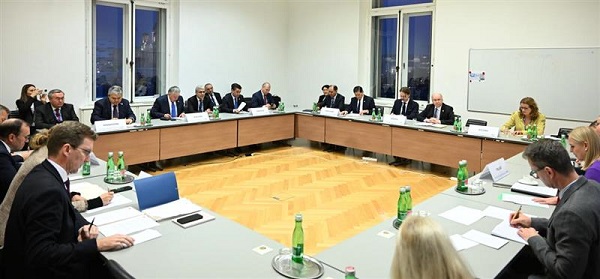
The first-ever meeting of Nordic and Central Asian foreign ministers, held on the sidelines of the OSCE Ministerial Council in Vienna last week, was not just a diplomatic courtesy — it was a breakthrough whose potential is almost too obvious to need stating.
Finland, holding the 2025 OSCE Chairmanship, brought together representatives of nine counties. Sweden immediately endorsed the initiative with enthusiasm. The chemistry was clearly there. Now the only question is whether we are serious enough to turn this one-off encounter into a permanent, structured format.
Anyone who has followed Central Asia’s astonishing diplomatic coming-of-age over the past decade will recognise the pattern. The region has built a whole series of successful “C5+” platforms — with the United States, the European Union, Germany, Japan, South Korea, India, China, Türkiye, the Gulf states, and others. Each of these dialogues has delivered tangible results: billions in new investment, transport corridors, renewable energy projects, university partnerships, and coordinated approaches to Afghanistan.
The Nordic countries have everything it takes to become one of the most productive partners of all — if we simply decide to show up regularly.
The fit between the two regions is almost perfect.
Central Asia sits on critical raw materials and rare earths that Europe desperately needs for batteries, wind turbines, and semiconductors. The Nordics have the clean tech, responsible mining standards, and circular-economy expertise that Kazakhstan, Uzbekistan, and the others explicitly say they want as they pursue their own net-zero ambitions.
Water and climate adaptation are even more urgent. The Aral Sea disaster, disappearing glaciers in the Pamirs and Tien Shan, and worsening floods and droughts affect millions. Finland, Sweden, and Norway are world leaders in integrated water management, early-warning systems, and glacier monitoring. Cooperation here would save lives and livelihoods, not just earn diplomatic brownie points.
The Arctic–Central Asia linkage is increasingly evident to scientists: melting permafrost and changing jet streams in the far north directly influence weather patterns thousands of kilometres south. Joint research and data-sharing would be low-cost and high-impact.
On the human dimension — rule of law, education, gender equality, anti-corruption, digital governance — the Nordic model is admired across Central Asia. Crucially, the Nordics have a track record of sharing experience horizontally, as equals, without the condescension that sometimes felt from other partners. Central Asian leaders repeatedly cite Finnish schools, Swedish parental-leave policies, and Danish transparency tools as models they actually want to study.
Afghanistan remains the shared neighbourhood nightmare. All nine countries in that Vienna room have a direct stake in preventing the country from again becoming a source of terrorism, opium, and refugee flows.
The Nordics bring principled advocacy for women and girls and substantial humanitarian experience; Central Asians bring proximity and cultural insight. A joint mechanism for humanitarian access, counter-narcotics, and carefully calibrated engagement with the Taliban would carry real weight in international forums.
The economic case is equally straightforward.
Swedish and Finnish companies are already among the largest European investors in Kazakhstan; Danish firms are building solar and wind plants in Uzbekistan; Norwegian expertise in carbon capture and offshore wind is studied across the region. Yet volumes remain far below potential. A regular ministerial dialogue would quickly unlock long-stuck framework agreements on investment protection, double taxation, and visa facilitation.
The financial vehicles already exist and are eager to scale up. The Nordic Investment Bank, NEFCO, and the Nordic Development Fund have mandates that explicitly cover Central Asia. A dedicated facility of even €150–200 million could leverage ten times that amount in private capital for green and digital projects.
Institutionalizing the format is almost unbelievably easy. No new bureaucracy is required. An annual ministerial meeting, rotating between Nordic and Central Asian capitals, with three or four working-level tracks (trade/connectivity, climate/water, Afghanistan, people-to-people), would be sufficient.
The OSCE provides the ready-made platform for security and human-rights discussions; the EU’s Global Gateway can supply additional funding without overlap.
For Central Asia, adding the Nordics diversifies partnerships and reduces dependence on any single external actor. For the Nordic countries, it offers meaningful influence in a region that will shape Eurasian security, critical raw materials, and the future of Afghanistan for generations.
The Vienna meeting proved the concept works. The priorities the ministers discussed — connectivity, sustainable development, stability in Afghanistan, and stronger people-to-people ties — are exactly the right ones.
All the signals from both sides are green. The political will is there. The complementary strengths are there. The financial instruments are there. The only thing missing is the decision to meet again next year, and the year after that.
We have waited long enough. It is time to make the Nordic–Central Asia dialogue permanent — for the sake of prosperity, security, and shared values across the wider Eurasian space. /// nCa, 8 December 2025