


Tariq Saeedi
The Statement: TAPI is more than an idea — it is an ideology.
The Spectrum: From Preposterous to Profound
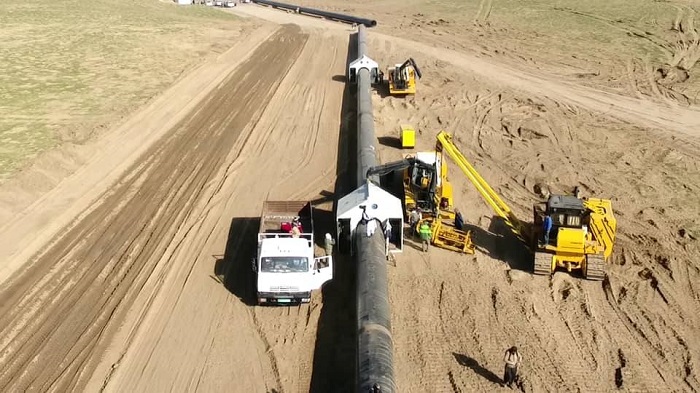
TAPI, as a gas pipeline project connecting Turkmenistan with Afghanistan, Pakistan, and India is an idea; an idea whose time has come, an idea that is akin to the force of nature.
TAPI, as a corridor, is the collective name for a number of ambitious projects including the TAP (Turkmenistan-Afghanistan-Pakistan) power transmission network, TAP fiber optics network, Central Asia–Afghanistan–Pakistan road and railway connectivity solutions, the partnership between Central Asia and Pakistan to make use of the ports of Pakistan for mutually beneficial projects, and much more.
However, is TAPI, on top of all of that, also an ideology?
This is the question I will explore here. And, in doing so, I will also try to answer a number of questions arising from brainstorming in this direction.
To understand that TAPI is an ideology, we should start with the difference between incubation and gestation.
Incubation is the process of keeping eggs warm to hatch them, while gestation is the period a mammal’s fetus develops inside the mother’s womb.
The birth of an ideology, except for the religious ideologies, is akin to the process of incubation.
This process is widely observed in history: liberalism began with ideas about individual rights in thinkers like John Locke; Marxism started as Karl Marx’s critique of capitalism; even nationalism or environmentalism originated as relatively simple notions that evolved into comprehensive worldviews with movements, doctrines, and sometimes dogmas attached. —– An idea grows into an ideology. — For an ideology to come into existence, there has to be a core idea.
As we move forward, let’s take with us a compact definition of ideology: “A system of ideas, beliefs, and values that shapes how individuals or groups understand society, politics, and their place in the world, often guiding their actions and goals.”
We will pick the scattered elements that, when put together, will help clarify that TAPI is indeed an ideology.
By stitching these elements together, we are reinventing the paradigm. — I would like to assert that TAPI, as an ideology, represents a unified vision – a comprehensive development paradigm for the region – not a collection of disconnected projects. — This is an exercise in deciphering the code of destiny.
As we begin collecting the dispersed pieces, it is important to mention that a living and evolving ideology has a rich wardrobe – attire for all occasions and every season.
Also, an ideology, during the different phases of time can have different names. These reflect the dominant side of the ideology during any given period. This is what we see in a cursory look at the history.
For example, the ideology of economic liberalism has been known as classical liberalism, neoliberalism, ordoliberalism, and market capitalism across different eras—each name reflecting a different emphasis while maintaining the core belief.
In another example, in the terminology of Marx and Engels the words communism and socialism are synonymous. As the ideology evolved, it acquired many names including Socialism, Communism, Marxism, Marxism-Leninism, Bolshevism, Leninism, Trotskyism, Maoism, Stalinism, and dozens other variants.
The current name of the ideology we are talking about is TAPI. It connects with the Revival of Great Silk Road and the economic and geopolitical unity of South and Central Asia. It represents a reality under the diktat of geography, wrapped in multiple layers of social, economic, spiritual, and historical commonalties.
There is no dearth of evidence to treat TAPI as an ideology. The paradigm we acquire after putting the pieces together, will help us chart the way forward while answering the questions that arise going forward.
* * *
Allama Muhammad Iqbal presented the concept of Pakistan on December 29, 1930, during his presidential address at the 21st annual session of the All-India Muslim League held in Allahabad Wikipedia (in what was then United Provinces of British India).
In this historic address, known as the “Allahabad Address,” Iqbal outlined a vision of independent states for Muslim-majority provinces in northwestern India, becoming the first politician to articulate what would become known as the Two-nation theory.
A group of students asked him to elaborate on the idea. He said that Pakistan will be located in South Asia but look toward Central Asia.
Allama Iqbal visited Spain in 1933, and saw that the country was politically unstable, grappling with the aftermath of World War I and the rise of fascism, while also dealing with internal political turmoil that would eventually lead to the Spanish Civil War in 1936.
Immediately after that, he visited Afghanistan at the invitation of the Afghan government. He was one of the very few politicians of India at that time who actually visited Afghanistan and saw the potential of partnership. This was the time when the Iron Curtain was already firmly in place. Nevertheless, he looked into the future and saw a different world. — Let’s keep in mind that his visits to Spain and Afghanistan after he had presented the concept of Pakistan already, after he had said already that Pakistan will be located in South Asia but look to Central Asia.
This was the early seed of TAPI as an ideology, even though a different name was attached to it. After all, a rose by any other name would smell as sweet.
* * *
Many years ago, I had a detailed conversation with General Mirza Aslam Beg, the only General of Pakistan who did not impose the martial law even when all the conditions were there. He explained his concept of ‘strategic depth’ to me.
Gen Beg, an unassuming person, is larger than life. In addition to his preference for restoring democracy in Pakistan at the time when he could have slapped martial law on the country, he is one of the few top generals of Pakistan who did not migrate to some other country after retirement. He continues to live in Rawalpindi.
His family is ethnically Chechan. His ancestors moved from Chechnya to Ferghana in the 13th century and came to India with the invading armies of Babur in 1526.
His idea of strategic depth is a fascinating concept, maliciously misinterpreted by the kind of people who believe that being loud is equal to being right.
In his concept of strategic depth, General Beg looks at Pakistan, Afghanistan, Iran, and Central Asia as an economically integrated region. He believes that economic backbone is a reliable form of defence. He thinks that the best victory in a war is when the war is averted through diplomacy and economic strength. The real victory is when you win the war without going to the battlefield. This is what I mean by strategic depth, he said.
This is also what TAPI as an ideology is capable of delivering.
* * *
The Sethi family was one of the prominent families in the present-day Pakistan with strong presence in Central Asia. Their enormous trading empire was run from their Sethi House, currently a museum, built in 1884 in Peshawar. They had strong presence in Central Asia, with Bukhara as their regional hub.
With the arrival of communism in Central Asia, this branch of the Silk Road dried up.
* * *
Lal Shahbaz Qalandar (1177-1274) is one of the most popular Sufi saints in Pakistan. His mausoleum, located in the Sehwan city of the Sindh province, is visited by millions of people of all religions every year.
His name was Osman Marwandi. Although most biographies mention him as a descendent of the Holy Prophet (PBUH), Obaidullah Baig (1936-2012) tole me that Qalandar was an ethnic Turkmen.
Obaidullah Baig, a scholar, Urdu writer/novelist, columnist, media expert and documentary filmmaker, was also an ethnic Turkmen and I had some long conversations with him when he visited Turkmenistan to make a documentary about the country.
There is plenty of common strands when it comes to spiritual commonalties between Pakistan and Central Asia – a strengthening factor for the TAPI ideology.
The mausoleum of Khwaja Yusuf Hamdani (1048-1140 is located in Merv, (currently Bairamali in Turkmenistan). He was the Grand Sufi Master because his students were the founders of all the major Sufi Orders including Naqshbandī, Yasavī, Qādrī and Chishtī.
Almost all of the Sufi branches in Pakistan, Afghanistan and Central Asia are traceable to Khwaja Yusuf Hamdani.
The shared spiritual heritage across the region is one of the strongest elements of the TAPI ideology.
* * *
There are more than 8000 common words between the Urdu, Turkmen and Uzbek languages. There are several dictionaries collecting these words. One of them is the Urdu-Turkmen common words compiled by Shah Merdan Qulmuradi.
* * *
TAPI ideology is a living and evolving organism. It manifests itself in many ways. An important example is the names of some of the ships in the Pakistan Navy.
There are four multi-role guided missile and air defence frigates in the Tughril Class. They are named Tughril, Taimur, Tippu Sultan, and Shah Jahan. —- Taimmur is named after Amir Taimur (Emir Timur – known in other times as Tamerlane), the founder of the Timurid Dynasty and a great hero for much of the Islamic world.
Tughril is named after Emperor Tughril (Abu Talib Muhammad Tughril ibn Mika’il) of the Great Seljuk Dynasty. Turkmenistan is ideologically a successor state of the Great Seljuks.
Tippu Sultan is named after the ruler of Mysore who fiercely resisted the British colonization of India and died in the last battle because of the betrayal by one of his own generals. He was an ethnic Turkmen.
Shah Jahan is named after fourth Emperor in the Mughal Dynasty in India.
The guided missile frigate Alamgir is named after the last major emperor in the Mughal Dynasty. The heavy corvette Babur is named after the founder of the Mughal Dynasty.
This is how the respect for the common heroes between Central Asia and Pakistan nurtures the TAPI ideology.
* * *
These are just some of the reasons why TAPI is not just an idea; it is an ideology. An entire book can be written to prove TAPI as an ideology but let’s leave it here and move on. We can see that describing TAPI as an ideology rather than just an idea is profound and not preposterous.
There is already a region-wide cognizance that TAPI is an ideology rather than just an idea. Kazakhstan and Uzbekistan have their own plans to create road and rail connections up to Pakistan through the territory of Afghanistan. Kazakhstan has announced the intention to go for 30% stake in the TAPI pipeline project. — the geography promises that the sum total would be more than its component parts.
* * *
Having established TAPI as an ideology rather than merely an idea, we must now interpret this paradigm accordingly. The natural gas pipeline remains the centerpiece—much as freedom of speech is central to liberalism or workers’ control is central to socialism—but it is not the entirety of the ideology.
TAPI ideology, properly understood, concerns itself with the integration of economic potential between Pakistan, Afghanistan, and Central Asia. The question is no longer simply ‘How do we move gas from Turkmenistan to India?’ but rather ‘How do we unlock the collective prosperity that geography and history have made possible for this region?’
* * *
This interpretation leads us beyond the narrow confines of cubic meters and compression stations. We are talking about ways not just to move the gas from Turkmenistan to the intended destinations, but also innovative ways to consume this gas more profitably. And together with this, how to propel the other elements of TAPI—the TAP power transmission network, the TAP fiber optics network, the railway and road networks between Pakistan and Central Asia, and ultimately the joint use of Pakistani ports for regional economic integration.
The gas pipeline is the thread that pulls the needle, but TAPI ideology is the entire fabric we are weaving.
* * *
When liberalism evolved from classical to neo to ordo, it did not abandon its core belief; it found new expressions suited to new circumstances. TAPI ideology operates on the same principle. Each element—gas, power, fiber optics, rail, roads, ports—reinforces the others; each makes the whole more resilient.
This is not mission creep. This is what happens when an idea matures into an ideology. It develops a rich wardrobe—attire for all occasions and every season. If the gas pipeline faces obstacles, TAPI ideology continues to advance through fiber optics, through power lines, through rail links. The ideology cannot be stopped by the slowness of any single project because it is larger than any single project.
* * *
The paradigm we have constructed allows us to interpret TAPI correctly. We are not building a gas pipeline with additional features. We are building regional economic integration with the gas pipeline as its most visible manifestation.
The difference is profound. A gas pipeline project succeeds when gas flows. TAPI ideology succeeds when the region prospers. A gas pipeline project can be delayed by technical obstacles. TAPI ideology adapts and finds alternative expressions.
Every ideology needs believers, and TAPI has them—from officials in Ashgabat to planners in Islamabad to businessmen who recognize opportunity to millions across the region who understand that their prosperity is linked to their neighbors’ prosperity.
But ideologies, once born, have remarkable staying power. They outlast their opponents. They adapt to circumstances. They wait patiently through unfavorable seasons, knowing that seasons change.
* * *
TAPI ideology is a practical framework for converting geographic proximity into economic advantage, historical connections into modern partnerships, and shared heritage into shared prosperity. The gas flows through pipes. The electricity flows through transmission lines. The data flows through fiber optics. The goods flow through railways and roads and ports. And through all of these, the region flows back together into the unity that history created and that modern borders merely interrupted.
The way forward begins with this understanding. Once we see TAPI as an ideology, we can pursue it ideologically—with patience, with flexibility, with multiple strategies, with long-term vision, and with the confidence that what serves the region’s destiny will ultimately prevail.
* * *
Now is the time to turn to the questions directly facing us.
In the queue, there are two questions right at the front:
1. Among the three major gas supply options for Pakistan – TAPI (Turkmenistan-Afghanistan-Pakistan-India) gas pipeline, IPI (Iran-Pakistan-India) gas pipeline, and Qatar LNG – which one is the best for Pakistan?
2. What is the natural gas supply-demand situation in Pakistan?
In the next part of this report, we will explore these questions. /// nCa, 1 December 2025 (to be continued . . .)