


Elvira Kadyrova
Senior Turkmen officials have outlined ambitious plans for expanded cooperation with Germany during the Turkmenistan Economy Days forum in Frankfurt, presenting a picture of a country achieving robust economic growth while actively seeking to deepen its integration into global financial markets.

Speaking at the forum on October 30, 2025, Deputy Finance and Economy Minister B. Yallakov and Serdar Yusupov, Deputy Head of the International Finance Department at Turkmenistan’s State Bank for Foreign Economic Activity, emphasized their nation’s strong macroeconomic fundamentals and openness to strategic partnerships with German financial institutions and businesses. The forum took place during what the United Nations has designated as the International Year of Peace and Trust, an initiative proposed by Turkmenistan itself, lending symbolic weight to discussions about expanding bilateral relations.
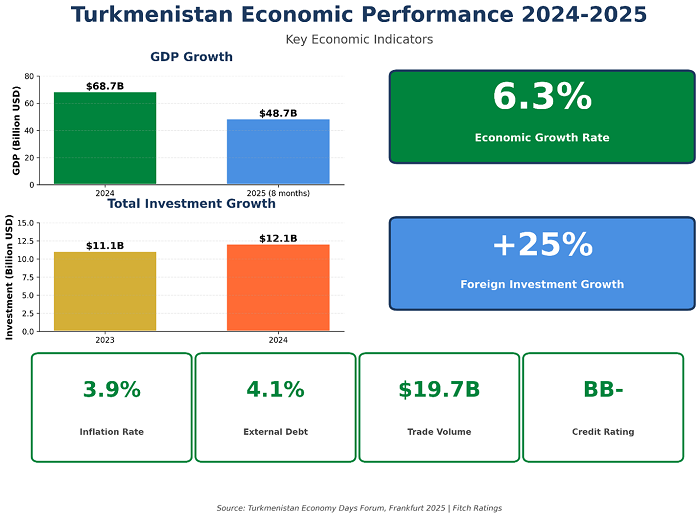
The economic data presented painted a compelling picture of stability and growth. Turkmenistan’s economy expanded by 6.3 percent in the first nine months of 2025, with GDP reaching $48.7 billion for the first eight months of the year, following a full-year 2024 GDP of over $68.7 billion. This growth trajectory has been maintained even amid what officials acknowledged as challenging global conditions marked by geopolitical instability, sanctions regimes, and currency restrictions.
Perhaps most striking was Turkmenistan’s fiscal discipline. External debt stood at just 4.1 percent of GDP at the end of 2024, with projections indicating it would fall further to 3.3 percent by mid-2025, according to Fitch Ratings data cited by the officials. Even more remarkably, the country has maintained zero domestic debt since January 2022. This conservative approach to borrowing, coupled with inflation rates of just 3.8 percent in 2024 and 3.9 percent through the first three quarters of 2025, has helped Turkmenistan secure a long-term credit rating of BB- with a stable outlook from Fitch Ratings, significantly enhancing its appeal to international investors.
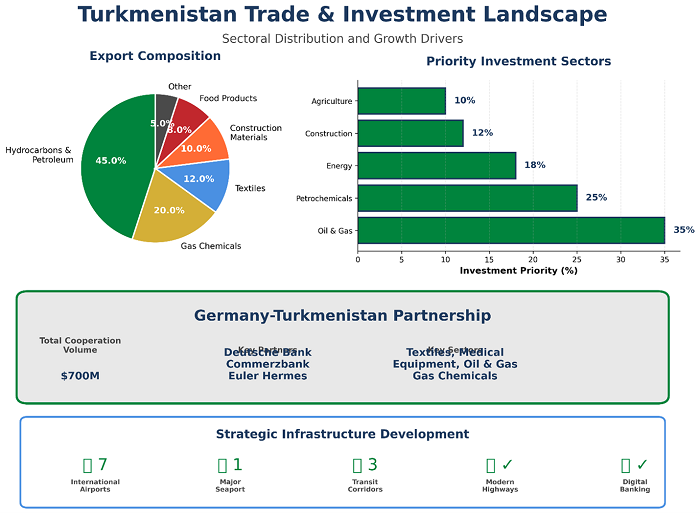
The country’s trade performance has been equally robust, with foreign trade turnover reaching $19.7 billion in 2024 and $14.1 billion in the first eight months of 2025. Crucially, exports consistently outweigh imports, with hydrocarbons and processed products forming the backbone of export revenues. Beyond natural gas, Turkmenistan has successfully diversified its export base to include petroleum products, gas chemicals, petrochemicals, electricity, mineral fertilizers, construction materials, textiles, and food products.

Investment flows into the Turkmen economy have shown healthy momentum, totaling more than $12.1 billion by the end of 2024, representing a 9 percent increase over 2023. Foreign investment accounted for 11.6 percent of total investment volume, amounting to nearly 5 billion manat and marking an impressive 25 percent increase year-over-year. For the first eight months of 2025, total investments reached $8.3 billion, with priority sectors including oil and gas, petrochemicals, energy, construction, and agriculture.
The existing partnership with German financial institutions has already yielded substantial results. Yusupov highlighted that Deutsche Bank, Commerzbank, and the export credit agency Euler Hermes have proven themselves reliable partners in implementing projects across key sectors of the Turkmen economy, including textiles, construction materials, medical equipment, oil and gas, and gas chemicals, with total cooperation volume reaching approximately $700 million.
Beyond these numbers, Turkmen officials emphasized significant reforms aimed at creating what Yallakov described as a competitive business and investment environment. The tax regime has remained stable for the past two decades, with just six main types of taxes whose rates remain unchanged, providing predictability for investors. Tax administration is being modernized through digitalization, and the filing process has been simplified. Any changes to tax legislation are promptly communicated through multiple channels, including media outlets, tax authorities, and official websites.
The banking sector has undergone particularly notable modernization. Turkmen banks now offer comprehensive services including corporate and retail lending, trade and project finance, deposits, bank cards, and both domestic and international payment systems. Integration into international frameworks is extensive, with banks connected to the Central Bank’s national payment system, the national bank card system, SWIFT, and the global Visa and Mastercard networks. The rapid expansion of e-commerce, internet banking, and mobile banking has dramatically increased accessibility and convenience for users.

Transparency and compliance have become hallmarks of Turkmenistan’s financial sector. Since 2011, all banks have operated according to international accounting standards, preparing financial statements under IFRS and undergoing annual independent audits. The sector strictly adheres to national and international legislation on combating money laundering, terrorist financing, and corruption. Banks have implemented automated financial monitoring systems, apply risk-based approaches to clients, follow “Know Your Client” protocols, and conduct thorough due diligence procedures. Partnerships with international information service providers such as LexisNexis Risk Solutions and Refinitiv underscore this commitment to global best practices.
Critically for international partners, Turkmen banks strictly observe sanctions regimes imposed by the United Nations, United States, European Union, and G7 countries, systematically identifying and preventing transactions that violate existing restrictions. This adherence to international norms, Yusupov emphasized, reflects Turkmenistan’s determination to be a reliable partner with a high international reputation.
Looking forward, Turkmen officials outlined an ambitious vision for structural economic transformation. Under President Serdar Berdimuhamedov’s leadership, the country is pursuing an industrial-innovative development model focused on diversifying the economy, transitioning to environmentally friendly technologies, embracing digitalization, and developing a circular economy through public-private partnership mechanisms. The goal is to create competitive domestic products with high added value based on local raw materials and resources, suitable for both domestic consumption and export markets.
Infrastructure development features prominently in these plans. Turkmenistan is positioning itself as a crucial hub for East-West and North-South transport corridors, leveraging its strategic location at the intersection of multiple interregional trade routes. The country operates seven international airports and has developed promising railway routes, including participation in the TRACECA transit corridor. It sits on the Trans-Caspian International Transport Route linking Europe and China, hosts the eastern branch of the North-South Transport Corridor along the Caspian Sea coast, and participates in the Lapis Lazuli Corridor connecting Afghanistan with Türkiye.
Highway modernization has been extensive, with the third phase of the Ashgabat-Turkmenabat highway scheduled for completion this year, further enhancing connectivity with Uzbekistan. The Turkmenbashi International Seaport, with its modern infrastructure and logistics capabilities, has improved access to global shipping routes and expanded maritime trade volumes. These developments are designed to facilitate domestic producers’ entry into new foreign markets and strengthen cooperation with partners across Europe, Asia, and the Americas.
Turkmenistan is also actively working toward World Trade Organization accession, with special attention being paid to finalizing its Memorandum on Foreign Trade Regime and implementing WTO standards and rules in phases. This work proceeds in close collaboration with the WTO Secretariat and other international organizations to determine optimal conditions for tariff policy implementation in priority economic sectors.
For German businesses and financial institutions, the officials outlined specific areas where cooperation could expand. These include financial services and investments, documentary business and trade finance, development of banking infrastructure using modern digital technologies, and training of highly qualified personnel. Priority sectors for collaboration include transport and logistics corridors, energy interaction and sustainable development, digital economy and e-government initiatives, and agriculture and water resources management.
The forum represented more than just a presentation of statistics and policy directions. It signaled Turkmenistan’s determination to deepen its integration into the global economy despite the complex international environment. As Yusupov emphasized, the country is consistently moving toward greater participation in global financial markets, increased international investment, and expanded financial ties with foreign partners. The spirit of friendship, mutual respect, and trust that officials said has historically characterized Turkmenistan-Germany relations provides a foundation for what both sides hope will be an expanded and mutually beneficial partnership in the years ahead. /// nCa, 30 October 2025