


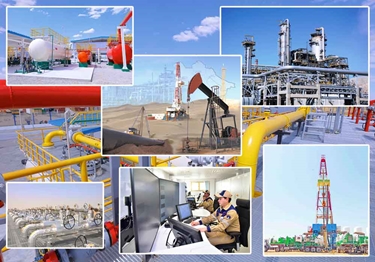
Global energy is in constant evolution, and recent decades are no exception. New factors and processes emerge over time, and technologies are developed that transform the global energy supply system, consequently reshaping international relations in this field.
For several decades, Turkmenistan has been implementing large-scale projects in the fuel and energy sector, which hold not only significant economic importance but also play a crucial role in strengthening regional and global energy security. To ensure this, reliable and stable energy supplies, diversification of energy sources, reduction of greenhouse gas emissions, development of renewable energy, and improvement of energy efficiency are essential.
Today, the energy policy of Turkmenistan, initiated by the National Leader of the Turkmen people, Chairman of the Halk Maslahaty Gurbanguly Berdimuhamedov, and consistently implemented under the leadership of President Serdar Berdimuhamedov, is aimed at the comprehensive development of the oil and gas industry and its dynamic integration into the international energy system.
The optimal use of the industry’s vast potential, strengthening its position in the global market by meeting the demand for high-quality, competitive, and environmentally friendly products, and implementing new infrastructure projects are among the priorities of the national strategy.
As the head of state noted during the expanded meeting of the Cabinet of Ministers on July 11 of this year, and reiterated at the government meeting on October 3, the national fuel and energy complex, as one of the key segments of the national economy, faces critical tasks. The President of Turkmenistan emphasized the need to develop this sector and diversify the export of natural gas to global markets.
President instructed to continue efforts to introduce the latest scientific achievements and innovative technologies to enhance the production capacities of the sector’s enterprises. He also directed to conduct geological exploration, continuously improve activities related to the exploration of oil and gas fields and the discovery of new ones, oil and gas extraction, and take comprehensive measures to promote hydrocarbon resources and their processed products on global markets, while continuing to produce competitive and environmentally friendly products by strengthening the material and technical base of the oil and gas industry.
It should be noted that Turkmenistan is a powerful energy state, ranking among the world’s leading countries in terms of natural gas reserves. The country strives to establish partnership with major oil and gas companies and reputable financial institutions, as well as significantly expand the geography of direct energy dialogue. In line with modern requirements, particular attention is paid to actively introducing the latest scientific and technological developments, innovative technologies, and digital systems into the national fuel and energy complex.
Enterprises in the power engineering, gas, and oil sectors operate successfully and achieve significant results.
In recent years, Turkmenistan’s electric power industry has increased its production capacities, with several modern power plants operating on natural gas as part of the state energy distribution system.
As is well known, the gas industry accounts for more than half of Turkmenistan’s industrial production. Currently, the gas sector is actively engaged in the exploration, evaluation, and industrial development of new fields using advanced technologies at all stages of the production process, from discovery and exploration to field operation, transportation, storage of hydrocarbons, and their processing into final products for consumers.
For instance, the “Galkynyş” gas field, recognized as a “super-giant” due to its reserves, has become one of the most reliable sources of gas. This year, successful drilling at this field resulted in a new inflow of natural gas from well No. 285, with a depth of 4,452 meters, yielding a daily output of 2 million cubic meters from layers at depths of 4,412–4,136 meters.
With the commissioning of new plants, the gas processing industry is also expanding. Priority is given to creating highly efficient production facilities with deeper processing of gas raw materials.
Targeted measures to increase oil production volumes are yielding positive results. Efforts continue to identify and develop new oil fields, improve the production infrastructure of oilfields using modern technologies capable of enhancing oil recovery.
A striking example of industrial achievement is the successful commissioning of a new well at the “Uzynada” field. With a depth of 6,830 meters, the well produces an impressive daily output of 70 tons of oil condensate and 75,000 cubic meters of natural gas. Significantly, this milestone was reached at the outset of the current year, declared the International Year of Peace and Trust.
It should be noted that the petrochemical industry in the country is also developing effectively. Significant results have been achieved in increasing production, expanding the product range, and improving the quality of products that meet global standards, ensuring the domestic market’s needs and creating a raw material base for the fuel and energy complex. Since oil is not only a fuel but also a foundation for the chemical industry, it is used in the production of clothing, footwear, plastics, paints, and electrodes for metallurgy.
In expanding the oil industry, special attention is paid to establishing the production of hydrogen fuel, biofuels, lighting and technical kerosene, liquefied petroleum gas, various types of diesel fuel, technical lubricating oils, polypropylene, calcined electrode coke, road and construction bitumen, and more.
Among the main directions of work in the context of achieving the Sustainable Development Goals (SDGs) are the intensification of mutually beneficial cooperation, the exchange of cutting-edge technologies in line with new environmental standards, attracting investors to supply advanced specialized equipment to the country, and introducing environmentally safe production processes.
The achievement of these goals, aimed at establishing direct and productive contacts, launching new projects, and familiarizing with global trends, is facilitated by annually held exhibitions, meetings, and conferences, which serve as an effective platform for widely promoting the achievements of Turkmenistan’s fuel and energy complex.
A vivid example of this was the International Roadshow Forum for Attracting Foreign Investments to Turkmenistan’s Economy, held on 23–24 April in Kuala Lumpur, Malaysia. The event was organized by the State Concerns “Türkmengaz” and “Türkmennebit,” the Chamber of Commerce and Industry of Turkmenistan, in partnership with the “Turkmen Energy Forum.”
During the pre-forum session titled “The Future of Hydrocarbon Production with Artificial Intelligence: Unlocking the Potential of Oil and Gas Deposits,” it was noted that the introduction of artificial intelligence technologies is expected in the near future, opening new opportunities for improving efficiency, reducing operational costs, and unlocking the vast potential of hydrocarbon deposits.
The second pre-forum session, “Prospects for the Development of Economic and Investment Potential of Turkmenistan and Malaysia: Focus on Education, Tourism, and Entrepreneurship,” discussed prospects for cooperation in the fields of artificial intelligence and cybersecurity, strengthening partnerships in education to train highly qualified specialists, developing joint initiatives to enhance academic mobility of students and foster bilateral ties, and promoting sustainable tourism through cultural exchange and responsible tourism initiatives.
The plenary session, titled “International Year of Peace and Trust: Turkmenistan’s Role in Shaping the Future of Global Energy and Sustainable Development,” addressed key aspects of Turkmenistan’s energy policy as the foundation of its energy diplomacy, regional stability, and global cooperation.
Participants of the forum, during thematic sessions such as “New Investment Opportunities in Turkmenistan’s Energy Sector: Natural Gas and Monetization,” “Accelerating Investment Attraction in Infrastructure Projects in Turkmenistan with a Focus on Construction, Transport, Information Technology, and Telecommunications,” “Investment Opportunities in Turkmenistan’s Energy Sector: Oil and Petrochemicals,” “Promoting Cooperation Between the Private Sectors of Turkmenistan and Malaysia: Development of Industry and Services,” and “The Role of Clean Energy in Building a Sustainable Future: Reducing Methane and CO2 Emissions,” discussed pressing issues. These included the efficient use of the country’s vast natural resources, the development of energy markets, attracting investments into mutually beneficial large-scale projects, new mechanisms for cooperation to enhance productivity at Turkmenistan’s largest fields, the introduction of environmentally friendly production processes, innovative technologies, and know-how, among other topics.
As emphasized by the speakers, the key factors contributing to Turkmenistan’s growing attractiveness to foreign investors are the country’s economic and political stability, as well as its robust legislative framework. Currently, in the context of specific projects aimed at long-term partnerships, the world’s largest gas field, “Galkynyş,” is being developed, particularly to supply natural gas to the transnational Turkmenistan–China gas pipeline, the Turkmenistan–Afghanistan–Pakistan–India pipeline, supplies to Uzbekistan, and swap supplies through Iran to Türkiye.
Discussions also covered projects aimed at optimizing production at existing fields, enhancing oil recovery, constructing modern petrochemical complexes, and developing new mechanisms for investment cooperation. Emphasis was placed on attracting investments for the development of oil blocks in the Turkmen sector of the Caspian Sea.
Specialists from relevant industries presented proposals at the forum on modern approaches to the exploration and production of hydrocarbon resources, expanding production capacities, deep processing of oil and natural gas, and manufacturing a diverse range of oil and gas chemical products with high added value, in demand both domestically and internationally.
During their presentations, experts from foreign oil and gas companies shared their accumulated experience and new scientific developments, as well as innovative projects, including those in the field of renewable energy sources. The forum participants were introduced to experimental developments for the practical use of solar and wind energy, as well as biofuels.
Turkmenistan continues to strengthen international cooperation by actively embracing innovative technologies and global best practices in the oil and gas sector. In this context, particular emphasis is placed on cultivating partnerships with leading foreign companies and business entities, guided by principles of trust, mutual respect, and shared benefit.
This commitment was clearly demonstrated during the international meeting and bilateral negotiations held on May 14 in Ashgabat. The National Leader of the Turkmen people, Gurbanguly Berdimuhamedov, engaged in high-level discussions with Tan Sri Tengku Muhammad Taufik, President and CEO of “Petronas”; Sultan Ahmed Al Jaber, UAE Minister of Industry and Advanced Technology and CEO of the Abu Dhabi National Oil Company (ADNOC); Suhail Al Mazrouei, UAE Minister of Energy and Infrastructure; and Ahmed Al Sayegh, UAE State Minister for Foreign Affairs.
The meeting was attended by heads and representatives of Turkmenistan’s fuel and energy complex, specialists from the oil and gas sector, and relevant industry authorities from the United Arab Emirates and the Malaysian company “Petronas.”
Following the discussions, agreements were signed between the State Concern “Türkmennebit,” “Petronas Çarigali (Turkmenistan) Sdn Bhd” (Malaysia), and “ADNOC Türkmenistan RSC Limited” (UAE), as well as between the State Concern “Türkmengaz,” “Petronas Çarigali (Turkmenistan) Sdn Bhd” (Malaysia), and “ADNOC Türkmenistan RSC Limited” (UAE).
A key factor driving the energy transformation of Turkmenistan’s fuel and energy complex is adherence to environmental requirements, grounded in a commitment to preserving ecosystems, adopting advanced technologies, and protecting the rights of future generations to a high-quality environment.
On June 5, the International Scientific and Practical Conference “Environmental Aspects of Implementing Innovative Technologies in the Development of Hydrocarbon Fields,” held in a hybrid format at the Natural Gas Research Institute of the State Concern “Türkmengaz,” addressed pressing issues of sustainable development in the energy sector amid technological and climatic changes. The conference focused on exchanging best practices and developing practical solutions to reduce negative environmental impacts.
Strengthening cooperation between Turkmenistan and leading global energy companies, reputable organizations, academic communities, and financial institutions focused on digital technologies and human capital development was the primary goal of the forum. Representatives from the UN, OSCE, World Bank, Asian Development Bank, European Bank for Reconstruction and Development, Gas Exporting Countries Forum, International Renewable Energy Agency (IRENA), Society of Petroleum Engineers (SPE), International Energy Agency (IEA), and prominent international companies such as “PETRONAS Carigali (Turkmenistan) Sdn Bhd,” “CNPC,” “Dragon Oil,” and “Eni S.p.A.,” along with heads and leading specialists from Turkmenistan’s oil and gas sector, participated in the discussions, including via video conferencing.
The forum continued with two thematic sessions: “Energy Prospects, New Technologies, and Environmental Aspects in the Development of Hydrocarbon Resources” and “Human Capital as a Driver of Environmental Responsibility: Leveraging Professional Expertise and Innovations to Address Methane and Carbon Dioxide Emissions.” During these sessions, international experts shared their experiences with Turkmen colleagues and outlined pathways for deeper cooperation in developing hydrocarbon fields with high sour gas content and reducing harmful atmospheric emissions. Turkmen scientists also presented their latest research in this area. Particular attention was given to fostering a sustainable safety culture and raising awareness of environmental risks.
Thus, by leveraging its vast resources, strategic geographic position, and commitment to peace to strengthen regional stability, Turkmenistan holds a leading role in shaping the future of global energy. This contributes to enhancing the economic strength of the Motherland and improving the well-being of the Turkmen people. ///TDH, 20 October 2025