


Yazgul Tirkishova, Chief Curator of the “Ancient Merv” State Historical and Cultural Reserve
Turkmenistan’s cultural heritage sites, including the “Ancient Merv” State Historical and Cultural Reserve, are inscribed on the UNESCO World Heritage List, affirming their outstanding universal value. The preservation and promotion of national cultural heritage are integral to Turkmenistan’s consistent state policy. Unique architectural and historical monuments, such as the mausoleums of the Prophet’s companions Al-Hakam ibn Amr al-Ghifari and Abu Buraidah al-Aslami, receive special attention from the state. Their restoration and protection are considered priority tasks aimed at ensuring the preservation of these sacred sites for future generations and all of humanity.

On the southern outskirts of ancient Merv, among gentle earthen hills concealing the outlines of long-vanished quarters, stand two modest yet profoundly significant mausoleums. These burial sites, attributed to the Prophet Muhammad’s companions Al-Hakam ibn Amr al-Ghifari and Abu Buraidah al-Aslami, are considered among the oldest Islamic shrines in Khorasan.
The architectural ensemble of the companions’ burial sites was thoroughly studied by the South Turkmenistan Archaeological Complex Expedition in 1950, providing deeper insight into its evolution and the dating of its various elements.
According to Muslim traditions, Hakam and Buraidah arrived in Merv in the 7th century as part of the first Arab detachments spreading Islam eastward. Unlike ordinary warriors, they were missionaries, carrying not only the new faith but also principles of justice and belief. Their sermons were marked by gentleness and persuasiveness, and their righteous lives were humble and exemplary. They brought a message of peace and unity rather than conquest, earning deep respect from the local population. After their deaths, they were buried side by side, and their proximity became an eternal symbol of spiritual brotherhood in the name of truth.
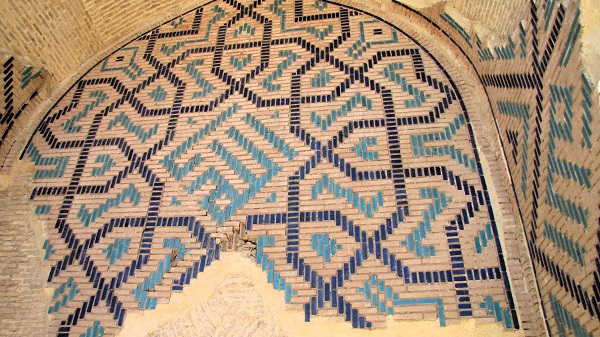
Fragment of tile ornamentation on the walls of the iwans (portals) behind the mausoleums – in the center, the word “Allah” in Kufic script (photo – nCa)
In this sacred place, time seems to pause, and the architecture feels like a continuation of prayer, with silence telling its own story. The site served as a spiritual gateway to Merv — the first sight greeting travelers upon arrival and the final memory they carried as they left the bustling city.
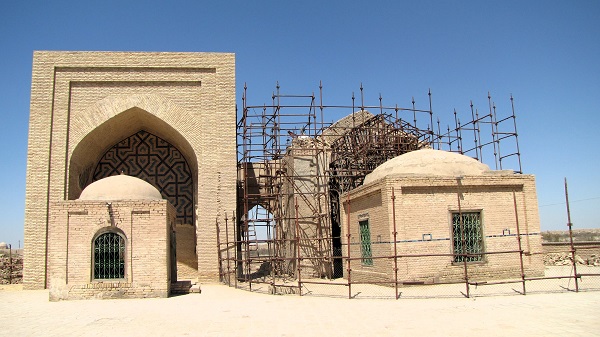
Mausoleums during reconstruction, 2012 (photo – nCa)
The architectural style of the two mausoleums embodies the spirit of the early Islamic era—marked by simplicity, serenity, and a profound sense of eternity. The time-worn brickwork astounds with its masterful craftsmanship, free of mosaics, carvings, or elaborate paintings: just clean, austere lines and the subtle interplay of light and shadow, crafting a unique poetry of space. In this restrained design, the essence of the age emerges, where faith was conveyed not through ornamentation but through actions, endurance, and enduring memory. The mausoleums captivate with their unassuming grace—their stark forms evoking timelessness, their silence echoing centuries of history.
This architectural simplicity mirrors early mosques, prioritizing function and spiritual meaning over opulence. The lack of ornate decorations keeps the focus on what truly matters: the memory of those buried here. While Islamic architecture later embraced elaborate designs, these mausoleums stand as enduring symbols of its original purity and restraint.
In the 15th century, Merv’s new rulers constructed two deep, vaulted iwans (portals) made of brick, aligned precisely with the mausoleums’ tombs. The architecture of the iwans echoes the metropolitan style of the Timurid state, which flourished in Central Asia, aiming not only to glorify rulers but also to honor Islamic missionaries – the ideological foundation of the spiritual and secular authority of Timur and his successors.
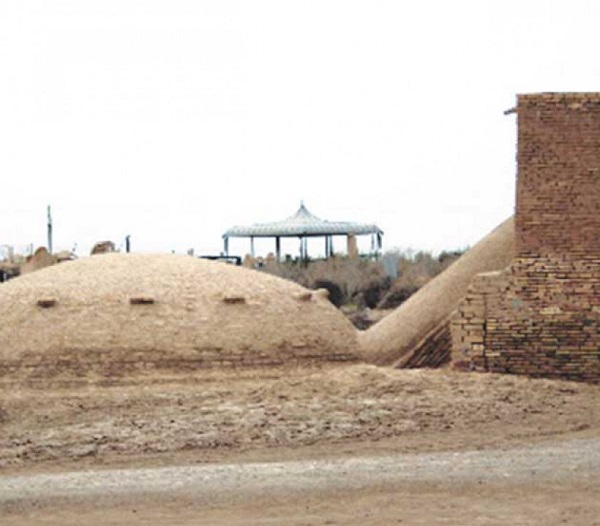
Between the mausoleums and the iwans stretches a paved courtyard, offering pilgrims and travelers shade from the blistering heat. Nearby, an ancient sardoba – an underground water reservoir – still stands, once a vital source of life for all who visited this place. Its presence reveals the site’s role not only as a burial ground but also as a vital stop along caravan and pilgrimage routes. Local traditions hold that the sardoba’s water had miraculous powers. A legend recounts a dire drought when wells ran dry, and thirst plagued the people. An elder knelt at the sardoba, praying for the companions’ blessing. Before he finished, a spring surged from the earth, filling the reservoir to the brim. This miracle saved nearby communities and strengthened their faith. Since then, visitors have come seeking miracles, drawn by belief in the power of spiritual intercession.
Local legends weave a rich tapestry of stories around these sacred sites. On rare nights, a soft glow is said to shimmer above the domes, while the breeze carries the faint scent of mountain herbs, as if echoing a distant era. Elders recount how women once brought newborns to these mausoleums, seeking divine protection, believing every child blessed beneath their shade carried a special grace. The burial ground of the Prophet’s companions has never faded from memory, referenced in medieval chronicles, etched on pilgrimage maps, and celebrated in poetic verses. It is said that a wanderer’s soul finds peace here, their heart soothed by solace. In an age of anxiety and loss, the mausoleums remain a point of stability, where the invisible past becomes almost tangible.
In spring, the surrounding hills bloom with flowers, lifting the mausoleums as if bridging earth and sky. On crisp winter evenings, their silhouettes emerge against a crimson horizon, like silent sentinels guarding the edge of history. They demand no words or praise; their purpose is simply to endure. In this quiet endurance lies their grandeur. Pilgrims, archaeologists, artists, and travelers – all who have visited carry away a sense of something profound, as if the boundary between eras has blurred, and a voice from the depths of time has whispered something vital. Such is the enduring power of these places: serene, unyielding, and a timeless reminder of faith’s roots and eternal values. ///Originally published by the newspaper “Neutral Turkmenistan,” 3 October 2025. (Photos from the archive of the “Ancient Merv” State Historical and Cultural Reserve / nCa archive photos)