


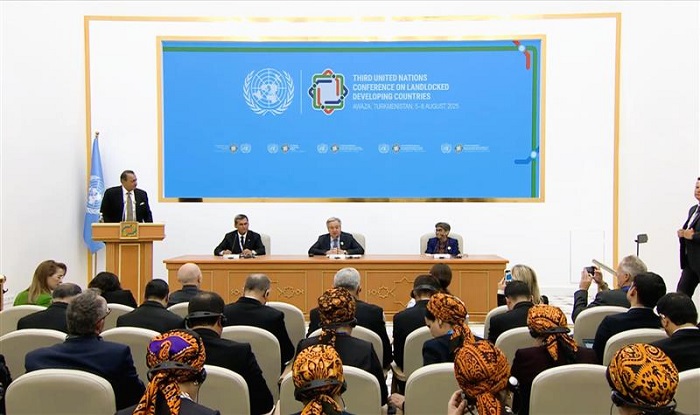
On August 5, 2025, a press briefing was held in the National Tourism Zone “Awaza” on the sidelines of the Third United Nations Conference on Landlocked Developing Countries (LLDCs). The event featured speeches by UN Secretary-General António Guterres and Turkmenistan’s Minister of Foreign Affairs Rashid Meredov, highlighting the conference’s significance and Turkmenistan’s role in fostering global cooperation.
António Guterres praised Turkmenistan for hosting this major international event, emphasizing the country’s commitment to international cooperation and sustainable development. Reflecting on his tenure as UN High Commissioner for Refugees, he commended Turkmenistan’s success in addressing statelessness. “After the collapse of the Soviet Union, many people were left stateless. In Turkmenistan, all such individuals were provided with a clear procedure for obtaining citizenship and became full citizens of this country,” he emphasized.
Guterres described the conference as a reflection of a new era of cooperation in Central Asia, rooted in shared priorities, regional solidarity, and collaboration. “At a time when global cooperation is under strain, this spirit of solidarity is more important than ever,” he said.
The Secretary-General drew attention to the challenges faced by over 600 million people in LLDCs, who are cut off from global finance and technology, burdened by debt, and vulnerable to conflicts and climate change risks. “These countries don’t need additional generosity—they need justice,” Guterres stressed, calling for equitable access to investments and opportunities to build inclusive societies and economies.
He outlined four key areas for immediate action:
1. Unlocking Economic Potential: Investments in infrastructure, education, digital technologies, and innovations, including digital infrastructure and access to advanced technologies like artificial intelligence, to boost productivity and open new markets.
2. Connecting LLDCs to the World: Developing trade corridors, regional integration, and robust logistics systems through partnerships with transit countries.
3. Building Resilience: Promoting green industries to ensure sustainable development.
4. Reforming the Global Financial System: Providing debt relief, concessional financing, and an international financial architecture that supports the most vulnerable countries.
Guterres noted that the Awaza Program of Action will serve as a roadmap for the next decade, aimed at creating jobs, increasing exports, reducing emissions, and transforming lives. The UN is ready to work with all countries to achieve tangible results.
Rashid Meredov reported on the successful conclusion of the conference’s first plenary session, which featured speeches by heads of state and government, ministers, senior UN officials, representatives of international organizations, financial institutions, academia, civil society, and the private sector. He emphasized the unified message that no country should be overlooked due to its geography.
Meredov expressed pride in Turkmenistan’s election as the chair of the conference, a testament to the international community’s trust and the country’s responsibility. “Our task is to ensure that all delegations—states and international institutions—can make a meaningful contribution to the discussions taking place in Awaza,” he stated.
The conference agenda includes five high-level thematic roundtables to address the key priorities of the Awaza Program of Action, as well as meetings with representatives of civil society, the private sector, youth, and women’s forums. Over 14 special events will facilitate the exchange of experience and knowledge across regions.
Meredov stressed that Turkmenistan views the conference not only as a platform for addressing challenges but also as an opportunity to develop forward-looking solutions tied to the shared priority of achieving sustainable development. He highlighted Turkmenistan’s international initiatives, announced by President Serdar Berdimuhamedov at the conference’s plenary session:
– A global initiative, “Global Medicine of the Future – Solidarity and Cooperation,” to prevent and respond to health threats.
– The development of an International Atlas of Transport Connectivity and a framework program for achieving a circular economy. ///nCa, 6 August 2025