


Elvira Kadyrova and Ravilya Kadyrova, Awaza, Turkmenistan
The Third United Nations Conference on Landlocked Developing Countries (LLDC3) commenced today in the National Tourist Zone “Awaza,” bringing together global leaders to address the unique challenges faced by landlocked developing nations. The conference themed “Driving Progress through Partnerships” aims to foster innovative solutions and strategic collaborations to unlock the potential of the 32 landlocked developing countries.
The opening ceremony featured statements from prominent figures, including H.E. President Serdar Berdimuhamedov of Turkmenistan, UN Secretary-General António Guterres, President of the General Assembly Philemon Yang, President of the Economic and Social Council Lok Bahadur Thapa, and Adylbek Kasymaliev, Chairman of the Cabinet of Ministers and Head of the Presidential Administration of the Kyrgyz Republic, acting as Chair of the Group of Landlocked Developing Countries. Also speaking were Sepp Schellhorn, State Secretary at the Federal Ministry for European and International Affairs of Austria, representing the host country of the Second UN Conference on LLDCs, and Rabab Fatima, Secretary-General of the Conference.

In his opening remarks at the conference, President of Turkmenistan Serdar Berdimuhamedov thanked the United Nations and the international community for their attention to the forum and support for the comprehensive development of landlocked developing countries.
He highlighted the global significance of the conference’s agenda, which encompasses humanitarian, economic, social, and environmental dimensions.
During his speech, the President of Turkmenistan emphasized humanitarian issues, underscoring that the country’s state policy is human-centered, focusing on addressing people’s needs and unlocking their potential. In this context, Serdar Berdimuhamedov proposed the initiative “Global Medicine of the Future – Solidarity and Cooperation,” aimed at creating systemic mechanisms for international medical diplomacy under the UN’s aegis. Turkmenistan is ready to provide practical proposals for implementing this initiative.
President Berdimuhamedov also stressed the importance of building sustainable communication systems for landlocked developing countries, proposing the creation of a Global Atlas of Sustainable Transport Connectivity. He emphasized the need for environmentally secure transport routes and the adoption of modern technologies.
A key point of his address was the challenges concerning the Caspian and Aral Seas. Turkmenistan noted the effectiveness of implementing the provisions of the UN Framework Convention on Climate Change and underscored the role of landlocked developing countries in the new global climate agenda.
Turkmenistan draws attention to the problems of preserving the Caspian Sea and saving the Aral Sea, proposing the development of a special UN program for the Aral Sea basin.

Turkmenistan offers the space and environmental initiative as a platform for dialogue on environmental issues in the Caspian Sea.
The President also addressed Turkmenistan’s approach to water issues, stating that they should be resolved based on adherence to international law, mutual consideration of interests, and the involvement of international organizations, particularly the UN.
In conclusion, the President noted that 2025, declared by the UN as the International Year of Peace and Trust, coincides with the 30th anniversary of Turkmenistan’s neutrality and the 80th anniversary of the UN. Turkmenistan emphasized that peace, trust, and priority are interlinked and form the essence of the country’s policy.

According to the UN Secretary-General António Guterres, the international community is gathering to address the challenges faced by landlocked developing countries and to affirm that geography should not determine fate.
Landlocked countries face significant obstacles, including trade barriers, high transportation costs, and vulnerability to market instability. Despite representing 7% of the global population, LLDCs account for only 1% of global trade. But this inequality is not inevitable and can be eliminated through collective action.
There is a need to accelerate structural transformation and economic diversification in landlocked developing countries by investing in high-value industries, local innovation and inclusive growth, with digital transformation playing a central role.
Guterres called for strengthening trade, transit, and regional ties by simplifying cross-border procedures, harmonizing standards, investing in physical infrastructure, and reforming the global trading system.

Philemon Yang, President of the General Assembly, emphasized that the five priority areas of the Awaza Programme of Action must be integrated into national policies through global efforts led by member states.
He stressed that the conference must send a clear message: geography does not define the fate of landlocked developing countries, which deserve access to opportunities, prosperity, and hope.

Nepal’s Permanent Representative to the UN, President of the Economic and Social Council Lok Bahadur Thapa, highlighted the importance of regional cooperation, noting that LLDCs are critical links in regional supply chains. Strengthening ties with transit countries and regional organizations is essential for enhancing connectivity, trade, and resilience.
The speaker noted the role of the upcoming UN Decade of Sustainable Transport. “This is a timely opportunity to make transport a driving force for sustainable development. I highly appreciate Turkmenistan’s leading role on this agenda.”

Adylbek Kasymaliev, Chairman of the Cabinet of Ministers of Kyrgyzstan, echoed the challenges of geographical isolation, high transport costs, and limited economic diversification faced by LLDCs, which remain on the periphery of the global economy amid crises like conflicts and climate instability.
The Awaza Programme of Action (2024–2034) offers a chance to correct past shortcomings and develop a sustainable plan for these countries.
He outlined Kyrgyzstan’s initiatives, including improving international highways, implementing an open skies policy, modernizing airports, and constructing the China-Kyrgyzstan-Uzbekistan railway, which will provide the shortest land route to the Middle East, Europe, and South Asia, positioning Kyrgyzstan as a regional logistics hub by 2030.
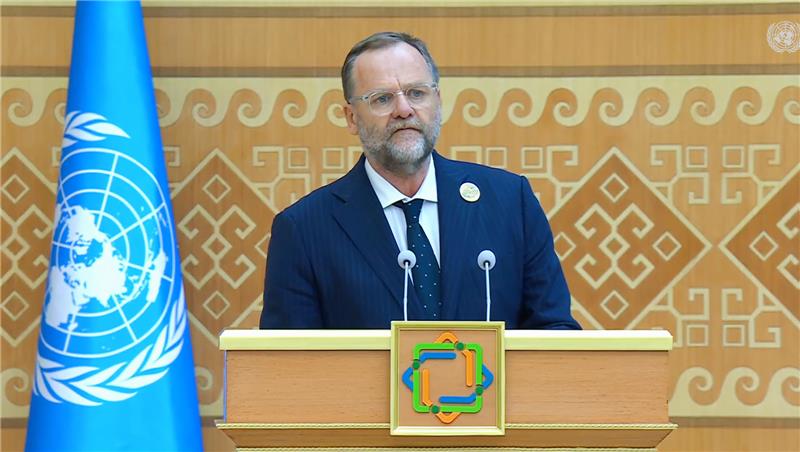
Sepp Schellhorn, State Secretary of the Federal Ministry for European and International Affairs of Austria, representing the host country of the Second UN Conference on Landlocked Developing Countries, highlighted Austria’s support for landlocked developing countries through various programs and initiatives.
In particular, a month ago, the Austrian government approved an additional €14 million allocation to support LLDCs in countries including Ethiopia, Burkina Faso, Uganda, and Afghanistan.
The speaker also emphasized the role of regional integration and the private sector, noting that they are key drivers of economic success and growth. Cooperation and innovative solutions are essential to address the challenges faced by landlocked developing countries.

Rabab Fatima, Secretary-General of the UN Conference on Landlocked Developing Countries (LLDCs), in her address, thanked Turkmenistan for the high level of organization of the event and expressed gratitude to the government and people of Turkmenistan.
Fatima emphasized that geography should not predetermine a country’s future. LLDCs possess rich resources and immense potential, and it is time to view them as full-fledged participants in the global economy rather than isolated territories.
The Awaza Programme of Action was highlighted as a key element of progress—an ambitious strategic plan for the next decade. It includes tools and mechanisms to transform current challenges into opportunities. The United Nations has already established a Roadmap and monitoring system to ensure the achievement of set goals.
Fatima outlined three strategic priorities for the LLDCs, both during the conference and beyond. First, addressing infrastructure and connectivity challenges is critical, as LLDCs often face a funding shortfall for infrastructure development, estimated at $500 billion. It takes 48 days for goods to reach LLDCs and 32 days to leave, with only 39% of their populations having internet access. The Awaza Programme proposes new infrastructure investments to address these limitations.
Second, promoting economic transformation and growth through transport freedom is essential.
Third, ensuring resilience to climate change is vital, as LLDCs bear 18% of global droughts and mudflows. For the first time, climate action and resilience are prioritized in the LLDC action program.
Fatima concluded by stating that the conference’s legacy will be measured not in words but in tangible outcomes—new roads, trade corridors, and digital connectivity.

***
The general debate followed, featuring a diverse lineup of speakers, including heads of state from Kazakhstan, Eswatini, Uzbekistan, Armenia, Tajikistan, Libya, and Sao Tome and Principe, as well as high-level representatives from countries such as Nepal, Mali, Georgia, Uganda, Azerbaijan, Russia. Other notable participants included ministers from Iraq, Egypt, Morocco, and Ethiopia, among others, alongside representatives from international organizations such as the United Nations Development Programme, the International Organization for Migration, and the Green Climate Fund.
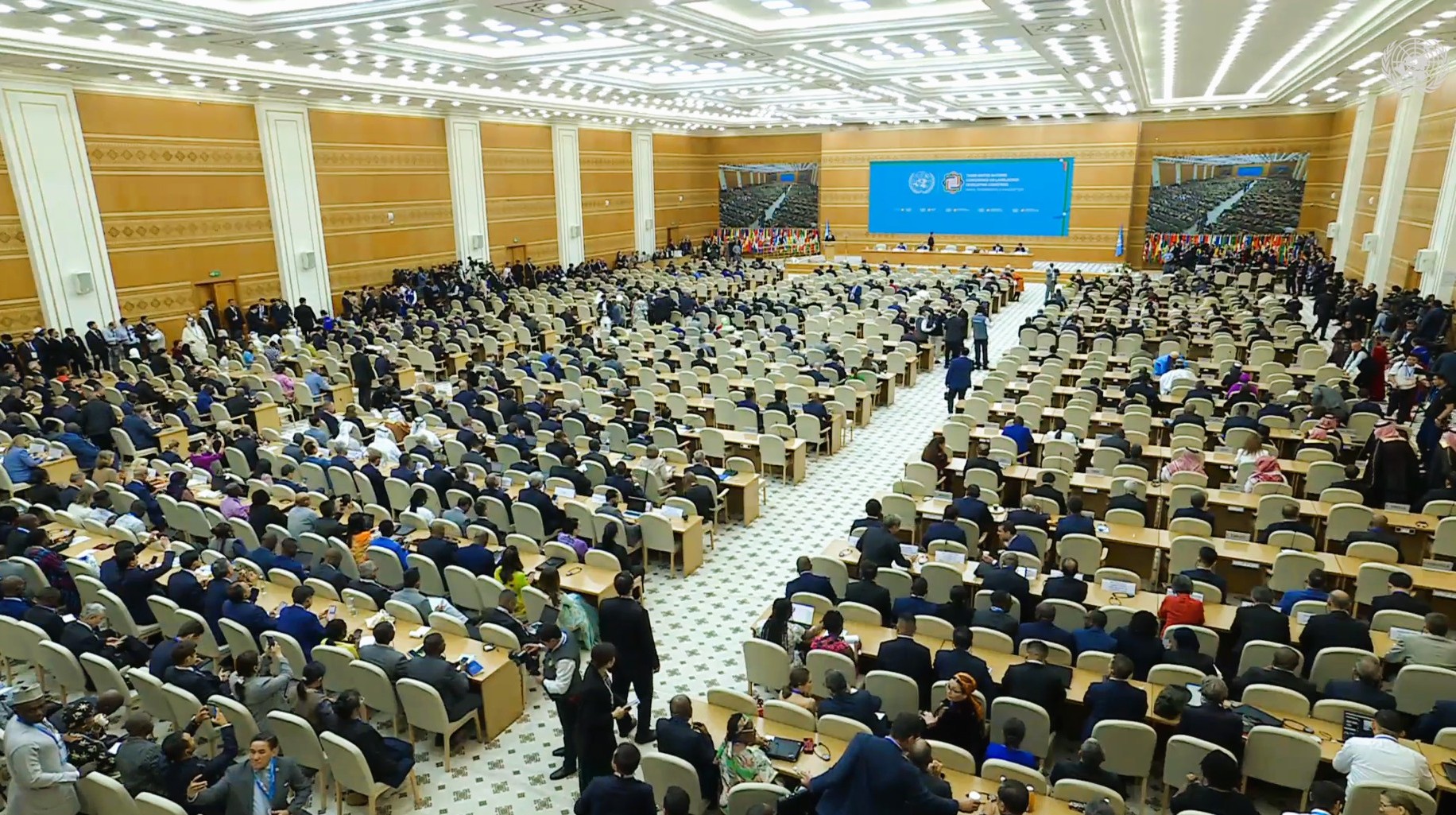
The conference focuses on critical issues such as transport connectivity, trade enhancement, and resilience to climate challenges, building on the Awaza Programme of Action (2024–2034), adopted by the UN General Assembly on December 24, 2024. With over 3,000 delegates from governments, international organizations, civil society, youth, academia, and the private sector in attendance, LLDC3 aims to promote global partnerships to accelerate inclusive and sustainable development for landlocked nations, home to over 500 million people. ///nCa, 5 August 2025